
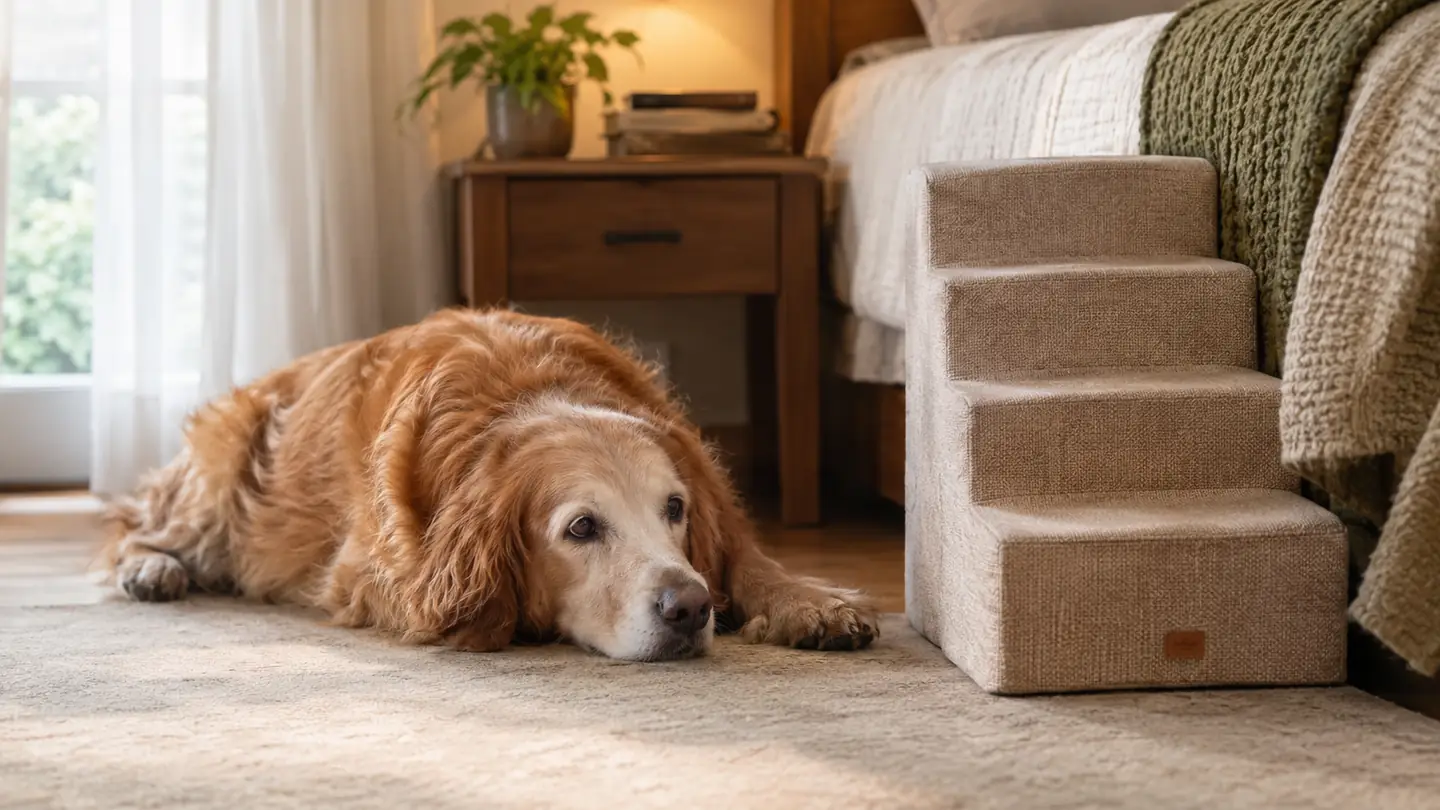
If your senior dog has started hesitating at the foot of the bed, you already know how helpless it feels. You watch them gather themselves, front paws up, back legs shaking, and then they either bail out or look at you to do the lifting. That was us about a year ago with Biscuit, our 11-year-old yellow Lab mix. He has hip dysplasia and stiff back legs, and the worst moments were first thing in the morning. The jump he had made a thousand times suddenly became a gamble.
Before I get into how we taught him to use the EHEYCIGA 4-step dog stairs, I want to be straight with you about one thing. These stairs are made for small and medium dogs, and the listing says the maximum weight recommendation is 35 pounds. Biscuit is 62 pounds, so we use them with him as a guided step, not as something he launches off. I keep a hand under his hips and we take it slow. If your dog is close to or over that weight limit, please talk to your vet about a ramp or a different setup. The training steps below still apply, but safety comes first.
The stairs that ended our morning yelping
The EHEYCIGA 18-inch, 4-step stairs sit beside our bed. They unfold in seconds, the fleece cover comes off for washing, and the high-density foam holds its shape. Check today's price on Amazon to see if they fit your setup.
Amazon Check Today's Price on Amazon →Why We Bought the Stairs
Biscuit has always been a bed dog. For nine years he jumped up like it was nothing. Then, about a year ago, he misjudged a jump up and yelped. I felt sick. He got down on his own, but after that he started standing at the foot of the bed and staring at me. That look broke my heart.
Our vet had already confirmed hip dysplasia on X-rays when Biscuit was nine. We started him on the joint supplement our vet recommended, and that helped some, but it did not fix the jump. Around the same time, Pepper, our 14-year-old gray shorthair, had stopped jumping onto the bed entirely. She would sit on the floor and meow until one of us picked her up. I needed something that would work for both of them.
What to Expect Before You Start
The first thing to know is that these stairs arrive compressed. The foam needs 24 to 48 hours to fully expand after you take it out of the bag. Do not try to train on day one. Set it up, let it fluff out, and give your dog time to get used to the idea.
The stairs are 24 inches deep, 15 inches wide, and 18 inches high, and they weigh about 6 pounds. The cover is fleece and it is removable, which matters when you have a dog who drags muddy paws across it. The core is a 30D high-density foam with an eco-friendly support board, so it does not wobble the way a cheap pillow step does.
One more thing before the steps: keep your sessions short. A senior dog with stiff joints does not need a forty-five minute training marathon. Five minutes, three times a day, is plenty.
What I Wish Someone Had Told Me First
I wish someone had told me that the first few days would feel like nothing was happening. Biscuit ignored the stairs for a full day. Pepper inspected them like they were a new piece of furniture and then went back to meowing at the bed. I almost packed them up. Do not do that. Give the foam time to expand and give your animals time to decide the stairs are not a threat.
I also wish someone had told me that the training is mostly about me, not the dog. I had to slow down, use the same word every time, and stop reaching for Biscuit the second he hesitated. The more patient I was, the more confident he got.
The Truth About Treats
You do not need a bag of fancy training treats. I used small pieces of plain chicken, because that is what Biscuit would cross the room for. Pepper preferred tiny bits of tuna, but she does most things on her own schedule anyway. The treat is not the point. The point is that the dog learns the stairs lead to something good.
Cut the treats small. A senior dog does not need extra calories while you are training. I am not a vet, so check with yours about what works for your dog, but a piece the size of a pea is plenty for a reward. The excitement matters more than the portion.
How Long Did It Take?
Pepper, at 10 pounds and with two good front legs, figured the stairs out in about three days. She was using them on her own within a week. Biscuit took longer, because he is heavier, stiffer, and more cautious. It was about three weeks before he would walk down the stairs with me beside him and no treat at the bottom.
Your dog might be faster or slower. That is okay. The only timeline that matters is the one your dog sets. If you push too hard, you will have to start over. If you go slowly, you might be surprised at how quickly a scared animal starts to trust a new thing.
Step 1: Unfold the Stairs and Let the Foam Expand
Take the stairs out of the compression bag and unfold them. Attach the removable cover according to the instructions. Then leave them alone for a day or two. I put ours beside the bed the moment they arrived, and I let the foam do its thing.
While the foam expands, let your dog sniff the stairs. Do not make a big deal out of it. Biscuit walked around them, gave them a suspicious look, and went to lie on his bed. That is fine. The goal is simply to get the stairs into the room so they stop being new.
If you have tile floors like we do, put a thin rug under the stairs before you start training. It keeps the stairs from sliding and it gives your dog a little more confidence. You can also use a yoga mat. Just make sure the stairs sit flat.
Step 2: Let Your Dog Investigate on Their Own Timeline
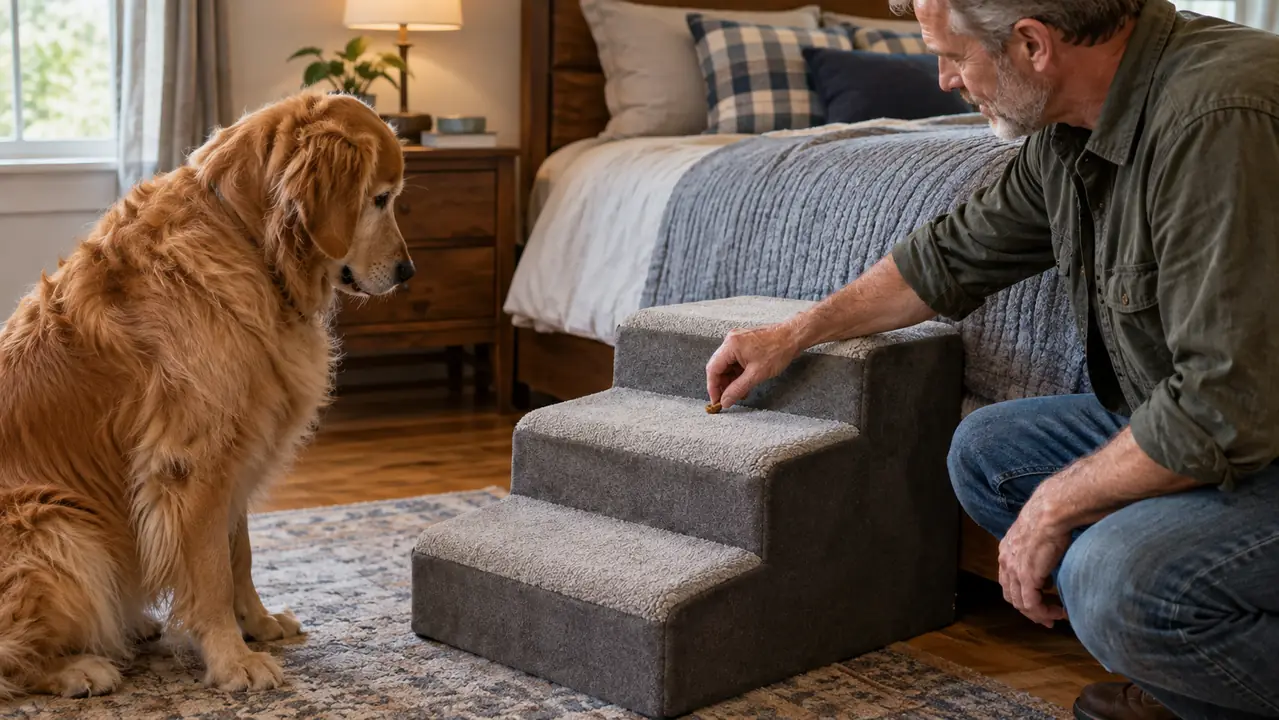
The next day, put a treat on the floor right next to the stairs. Let your dog find it. Then put a treat on the first step. Do not lure them up the whole staircase at once. One step is enough. Biscuit took a treat from the first step on day two. Pepper was on top of the stairs by the end of the first hour, because cats have no respect for a training plan.
If your dog will not take a treat from the stairs, that is okay. Walk away and try again later. The worst thing you can do is hold them by the collar and force them onto a step. That teaches them the stairs are scary. Let them decide when they are ready.
Keep the stairs in the same spot during this phase. Moving them around confuses an older dog. Once your dog is comfortable with the stairs on the floor, you can start thinking about the bed.
Step 3: Use a High-Value Treat to Lure One Step at a Time
Once your dog is comfortable with the first step, start luring them higher. I used small pieces of plain chicken because Biscuit would do almost anything for chicken. Put a piece on the second step, say your cue word, and let them take it. Then the third. Then the fourth. Go at their pace.
The cue word matters. I say 'step' every time Biscuit puts a paw on a stair. After a few days, he started moving toward the stairs when I said the word. You do not need a fancy command. You need consistency. Use the same word every single time.
Some dogs will try to jump from the floor to the bed and skip the stairs entirely. That is normal. Gently guide them back to the bottom step and start again. The whole point is to teach them that the stairs are the easier path, not to police their every move.
Step 4: Practice the Full Trip Up and Down
Going up is the easy part for most senior dogs. Going down is where they get nervous, because they have to lower their stiff back legs onto a step they cannot see. Teach down the same way you taught up. Put a treat on the floor at the bottom and let them find it. Do not pull them down by the collar.
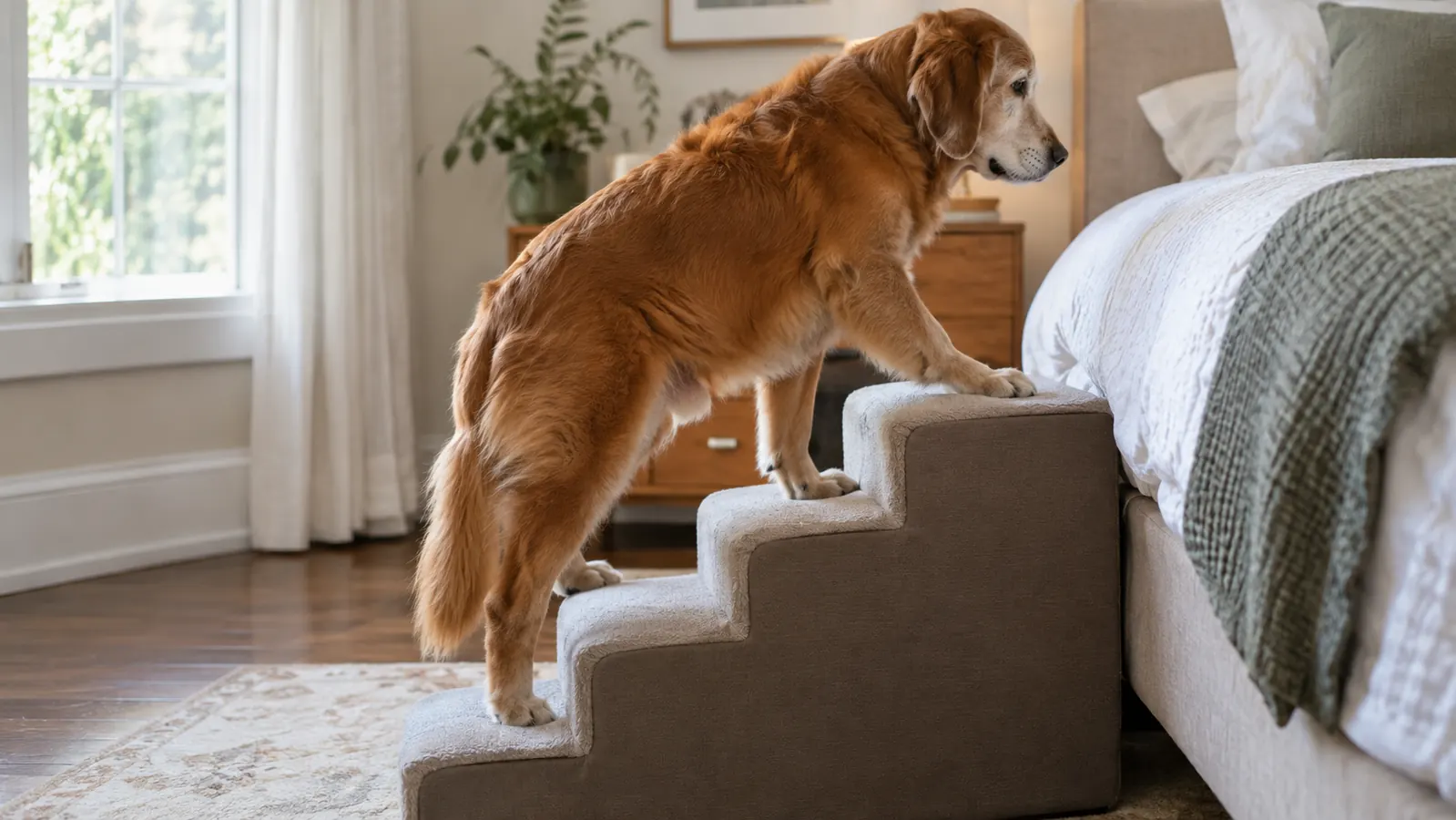
Biscuit needed help with this part. I stood beside the stairs, put one hand under his chest and one hand under his hips, and walked him down one step at a time. He did not love it at first, but after a few repetitions he understood that the stairs would hold him. Keep the sessions short and end on a success.
Going up, I did the opposite. One hand under his chest, one hand under his belly, and a lot of quiet encouragement. I never lifted him onto the bed. I let his feet find the steps. The stairs are a tool, not a taxi service.
Step 5: Move to the Bed and Repeat in Short Sessions
When your dog is comfortable on the stairs on the floor, it is time to put the stairs next to the bed. This is a new context, so expect a little regression. Biscuit acted like he had never seen the stairs before. That is normal. Go back to the treat on the first step and work your way up again.
Once your dog is going up and down beside the bed, practice the actual trip onto the mattress. For Biscuit, I put a treat on the bed, let him climb the stairs, and then helped him step onto the mattress. Coming down, I stayed close and kept a hand under his hips. Pepper, who is well within the weight limit, now uses the stairs on her own to get up and down. She still meows for attention sometimes, but she does not need a lift.
After about a week of this, Biscuit started using the stairs without being asked. He still waits for me to stand beside him, and I still keep a hand near his hips. That is okay. The goal was never to make him independent. The goal was to stop him from hurting himself.
What Else Helps
Stairs are one part of the picture, not the whole picture. We also talked to our vet about joint supplements and about keeping Biscuit at a healthy weight. I am not a vet, so I will not tell you what to give your dog. What I can tell you is that the stairs work best when they are part of a routine: short walks, a warm bed, and a patient owner.
On the practical side, I keep a thin rug under the stairs so they do not slide on the tile floor. I also check the cover every few weeks to make sure it is still snug. The cover comes off for washing, and I wash it more often than I wash my own sheets, because Biscuit drags half the yard onto it.
If your dog has a favorite blanket or bed, put it near the stairs. Familiar smells help. Biscuit has a Bedsure orthopedic bed in our bedroom, and I noticed he was more willing to try the stairs when his bed was close by. It sounds silly, but comfort matters.
After about three weeks of short sessions, Pepper was going up and down the stairs on her own. Biscuit still needs me beside him, but he no longer stands at the foot of the bed waiting for someone to lift him.
When to Call Your Vet
If your dog is in pain, not just hesitant, call your vet. We called ours when Biscuit was nine, and the X-rays showed hip dysplasia. That diagnosis changed how we handled everything. I am not a vet, and I do not play one in this article. If your dog is limping, crying out, or refusing to put weight on a leg, get professional help before you worry about training.
The stairs that made our bedroom safer
The EHEYCIGA 4-step stairs have been beside our bed for about a year. They are not the right tool for every dog, especially a 62-pound Lab, but for a small or medium dog they are a simple, sturdy option. Check today's price on Amazon and see if they fit your home.
Amazon Check Today's Price on Amazon →