
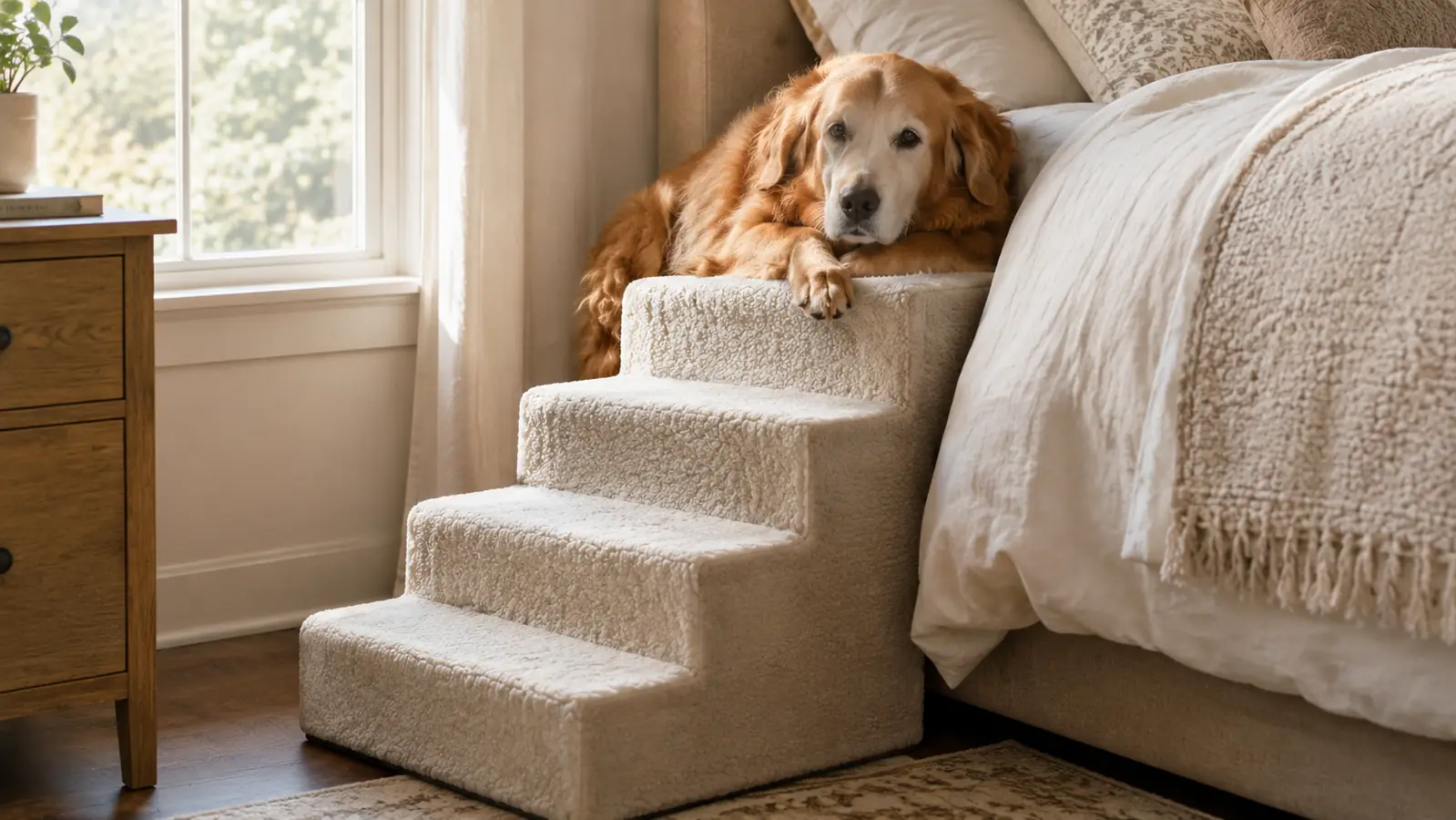
If you have a senior dog with stiff back legs, you have probably stood in front of a bed and watched them think about jumping. I did that with my 11-year-old yellow Lab mix, Biscuit, for months. He would pace, crouch, back up, and try again. Then one morning he misjudged the jump, caught a back leg on the edge of the mattress, and yelped. That was the day I started comparing dog stairs vs dog ramp for senior dogs, and I have strong opinions now.
The short answer: for a dog who only needs to get onto a bed or sofa, a set of stairs like the EHEYCIGA dog stairs is usually the better buy. A ramp wins when you need a long, gentle incline for a very tall surface or a dog who cannot lift their feet at all. For most households with an 18-inch bed and a stiff but still mobile dog, stairs are easier to place, easier to learn, and easier to live with. Here is the honest breakdown from someone who is not a vet and says so.
That yelp happened about a year ago. Biscuit had been fine the night before, and then he just missed. He caught his right back leg on the edge of the mattress, yelped, and spent the rest of the evening pressed against my leg on the couch. I spent the next week trying to solve it the cheap way. First I stacked two firm couch cushions against the bed. They slid apart the first time he put weight on them, and he looked at me like I had broken the bed. Then I tried a folded blanket, which was worse, because it moved under his paws. Then a friend lent me her folding ramp, the kind she uses for her elderly dog. It was a good ramp, sturdy and wide, and it taught me something important: Biscuit would not use it. He walked up it twice, when I lined it with treats, but every other time he walked around it and stood at the edge of the bed, waiting for me to lift him. That was when I stopped guessing and started measuring. Our bed is 18 inches from the floor, and the EHEYCIGA 4-step stairs are built for exactly that height, with a 24-inch depth that sits flush against the frame. I ordered a set, and a year later I have a very clear picture of where each option earns its place. I gave that ramp back to my friend, and I will be honest: I have borrowed it twice since, once for the vet and once for the car. That is the honest place for a ramp in our house, the car, not the bedroom.
| EHEYCIGA Dog Stairs | Folding Dog Ramp | |
|---|---|---|
| Best for | Beds and sofas up to 18 inches high | Taller surfaces, vehicles, or dogs who cannot lift their feet |
| Learning curve | Most dogs get it in a few days with treats | Some dogs never trust the incline; needs practice |
| Foot placement | Four separate steps give a clear place for each paw | One long surface can be harder for a dog with hip stiffness |
| Footprint | 24"D x 15"W x 18"H, fits tight against the bed | Longer footprint; needs clearance to fold and unfold |
| Stability on tile | Wide base and high-density foam grip the floor well | Needs a non-slip strip or mat on smooth floors |
| Portability | Lightweight, easy to move room to room | Folds flat, better for travel and cars |
| Joint-friendly angle | Steeper but short climb, step by step | Gentler angle, longer distance |
Where EHEYCIGA Wins
The EHEYCIGA dog stairs win on the thing that matters most in my house: Biscuit actually uses them. He learned in about three days, and the reason is simple. Each of the four steps gives him a clear, separate place to put a paw. With hip dysplasia, he does not think in terms of a smooth continuous motion. He thinks in terms of one small lift at a time. The 18-inch height matches our bed exactly, and the 24-inch depth sits flush against the frame with no gap for a nervous paw. The first few nights I stayed beside him, ready to catch him if he slipped. He never needed me to, but I think knowing I was there helped him trust the new thing.
They also win on floor space and stability. The stairs measure 24"D x 15"W x 18"H, so they tuck into the side of the bed without turning the bedroom into an obstacle course. The 30D high-density foam and the eco-friendly support board keep them steady when Biscuit puts his front paws on the top step. On our tile floors, the wide base stays put. I sewed a spare cover for ours out of habit, because I sew, and the removable fleece cover means I can wash the stairs the same way I wash Biscuit's bed.
The learning process was not magic. Day one, I put a small piece of chicken on the second step, then the top step, then the bed. Biscuit followed the trail, and by day three he was using the stairs without any food involved. What surprised me was how quickly it became a habit. Now, at 10:30 most nights, he walks over to the stairs, climbs them one careful step at a time, and turns around twice before he lies down. The stairs weigh about 6 pounds, so I can move them from the bedroom to the couch in the living room without thinking about it, which matters on the days his hips are stiff and he wants to be where I am. The stairs also made the middle-of-the-night trips safer. Biscuit used to wake me at 2 AM to go out, and the old routine of lifting him off the bed was hard on both of us. Now he comes down on his own, one step at a time, and I just open the door.
One thing the care instructions mention is worth repeating: the foam arrives compressed and needs 24 to 48 hours to fully expand. I unfolded ours, attached the removable fleece cover, and left it alone for a day. When Biscuit first climbed it, the steps were already firm. The cover itself has held up better than I expected. I wash it every couple of weeks on a gentle cycle and hang it to dry, and after a year it still zips on and off without fighting me. That is the kind of detail I notice because I sew.
The stairs my stiff old dog actually uses every single night
The EHEYCIGA 4-step dog stairs sit beside our bed, sized for beds up to 18 inches high, and give a stiff old dog a safe way up and down. No yelping, no hesitation, no midnight panic.
Amazon Check Today's Price on Amazon →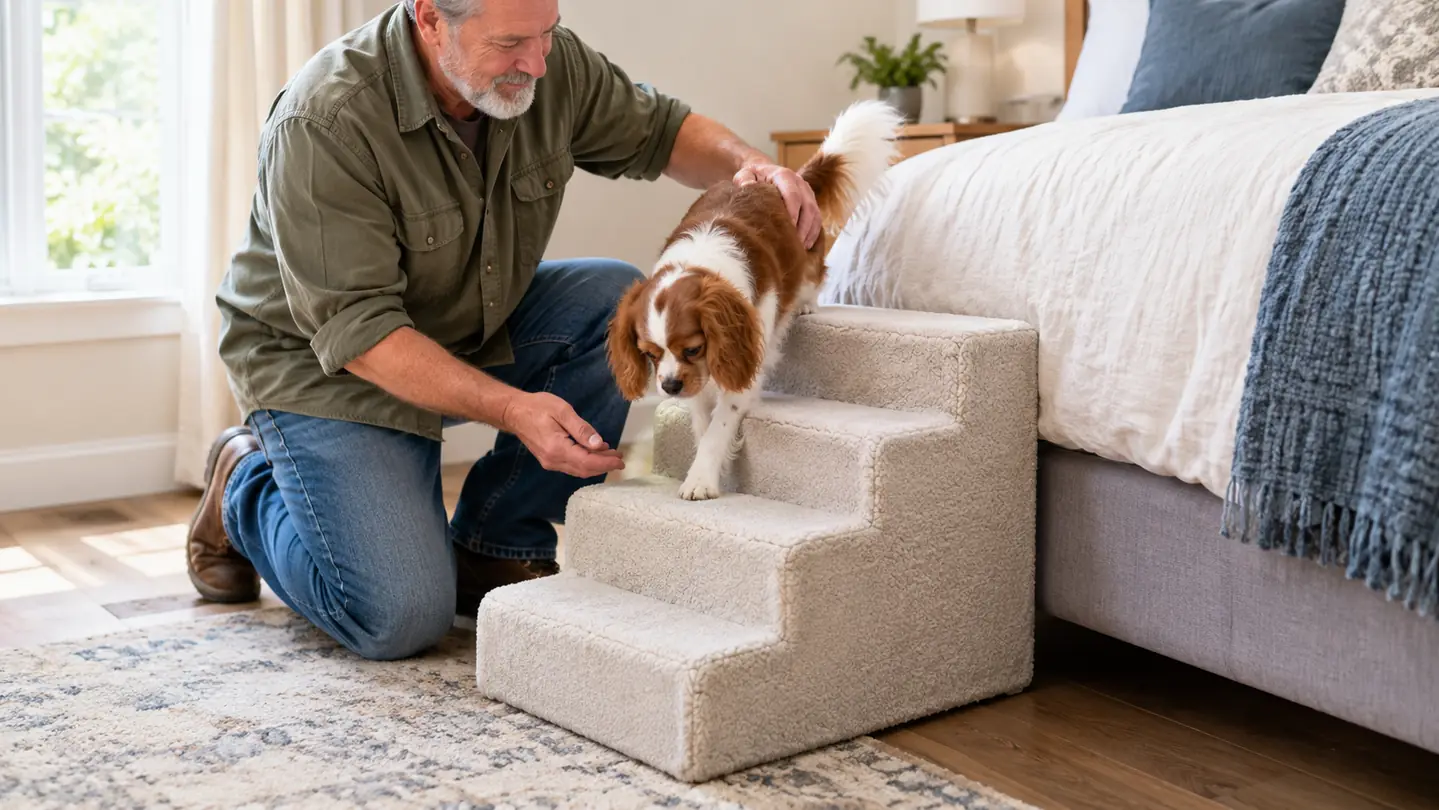
Where the Ramp Wins
I am not going to pretend the ramp never makes sense, because it does. A ramp wins when the surface is too tall for four steps to help. Our bed is 18 inches, which is exactly what the EHEYCIGA stairs are built for. But if your bed is 30 inches, or your dog needs to get into an SUV, a longer ramp with a gentler angle is the kinder option. A ramp also wins for a dog who cannot lift their feet at all, the kind of dog who shuffles rather than steps. For that dog, a continuous incline is the only realistic choice. The other case for a ramp is a dog who has never learned to use stairs at all. Some dogs, especially ones who spent their whole lives in a single-story house, will not climb a step no matter how many treats you offer. For those dogs, a ramp is the gentler introduction.
The ramp also wins on portability. A folding ramp folds flat and rides in the car, which is genuinely handy for vet visits and road trips. The tradeoff is that a ramp needs a long, clear run-up, and on tile floors that often means adding a non-slip mat or strip. It also takes most dogs longer to trust. Biscuit would walk up a ramp if I put a line of treats on it, but he never chose it on his own. He chose the stairs, because stairs match the way a dog already thinks about climbing onto furniture.
Here is what I learned from the borrowed ramp, and it is the part nobody puts in the product photos. A ramp needs a run-up. The borrowed ramp would have had to start about three feet out from the bed to keep the angle gentle enough for Biscuit's hips, which meant it blocked the path to the bathroom in our bedroom. In a bigger room, or against a wall with nothing behind it, that is a non-issue. In our house, it was the difference between a ramp that got used and a ramp that got folded up and stored behind the door. I also noticed that Biscuit's back feet slid on the smooth ramp surface when he was tired, and I would have needed to add a non-slip strip before I trusted it for daily use. I measured the run-up, because that is the kind of thing I do now. From the foot of the bed to the bathroom door is about five feet, and the ramp needed most of it.
There is also a real difference in how the two options feel to a dog with hip dysplasia, and I think it comes down to anticipation. A stair is a series of small decisions, and each one is easy. A ramp is one long commitment, and for a dog who already feels unsteady, that commitment can look scary. I watched Biscuit stop halfway up the ramp one afternoon, turn around, and come back down. He did not do that on the stairs, not once. If your dog is confident on ramps, that is a different story. But most stiff old dogs I know are not.
Biscuit learned the EHEYCIGA stairs in three days and has used them every night for a year. He never once chose the ramp on his own.
Who Should Buy Which
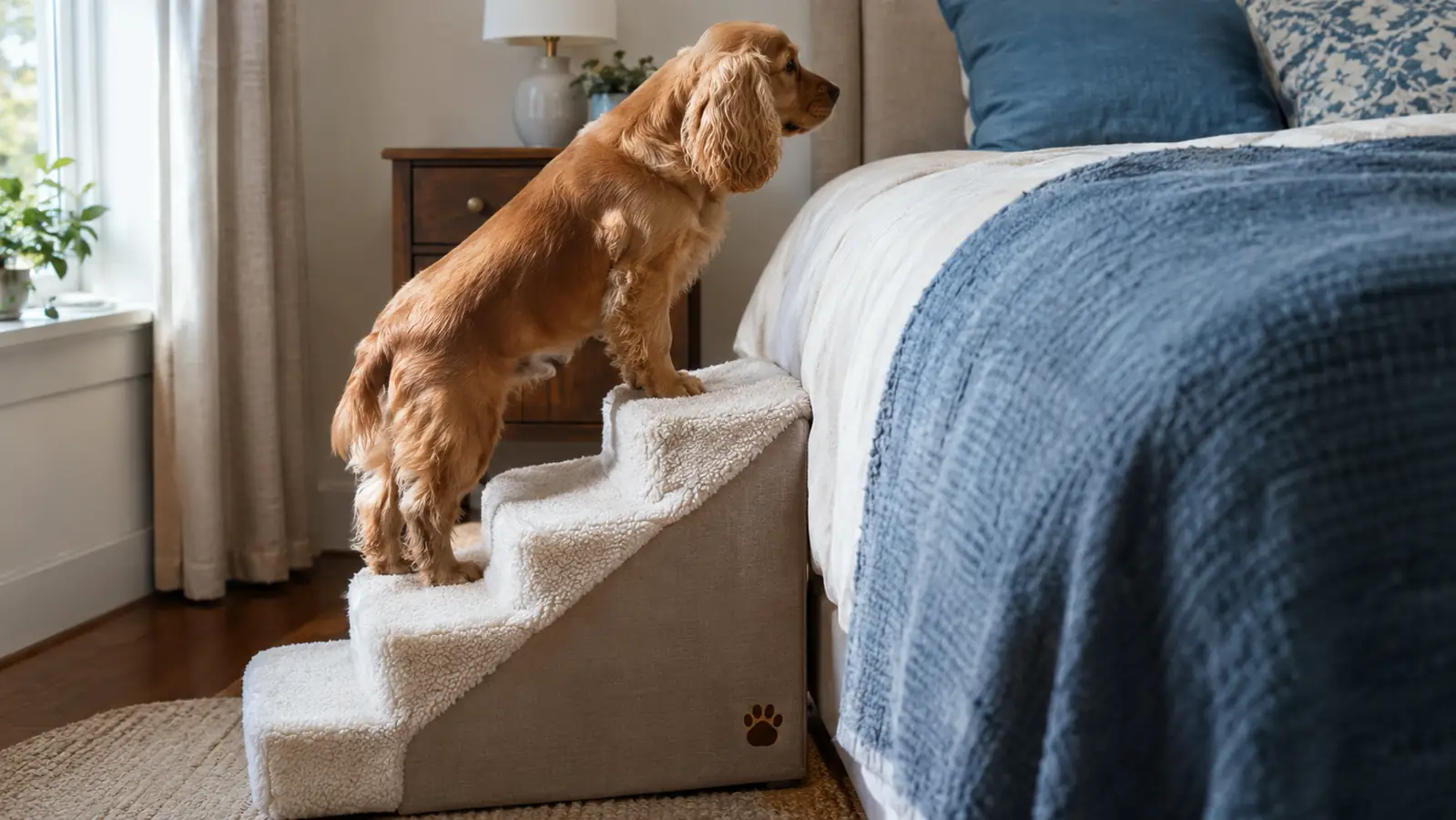
Buy the EHEYCIGA dog stairs if your bed or sofa is 18 inches or lower, your dog is small to medium, and your dog can still lift their paws one at a time. That describes most senior dogs who are stiff but not immobile. The 4-step design gives them a rhythm: step, step, step, step, and they are on the mattress. The 35-pound weight recommendation means it is perfect for a 10-pound cat too, and my 14-year-old gray shorthair, Pepper, uses ours more than Biscuit does some days.
Buy a ramp if your dog is well over the recommended weight limit and you are not willing to take the risk I took, if your bed is much taller than 18 inches, or if your dog cannot manage even a low step. And if your dog has a condition that affects their balance or their ability to lift their feet, talk to your vet before choosing either one. I am not a vet, and I do not play one on the internet. I am just a retired school office manager in Mesa, Arizona, who watched her old dog figure out which path was easier on his joints. And if you are choosing between the 4-step and the 5-step version, measure from the floor to the top of the mattress, not the bed frame. That is the number that matters.
A few practical notes from a year of living with the stairs. Put them where the dog actually jumps, not where the furniture looks best. The stairs live on the side of the bed Biscuit uses, and I moved them from the foot of the bed to the side after the first week, because that was where he wanted to climb up. Keep the path in front of the stairs clear. A pair of shoes or a laundry basket in front of the bottom step is enough to make him hesitate. And if you have tile floors like we do, give the stairs a day to settle before you trust them fully. The 24-inch base stays put, but I still check that the cover is pulled tight, because a loose cover can bunch under a paw.
One honest note about that weight limit, because you will see the number and you will wonder. The listing recommends 35 pounds, and Biscuit is 62. I did not buy these stairs because he fit the number; I bought them because he needed help, and they have held up through a year of nightly use. But I would not push a weight limit on purpose, and if your dog is over the recommendation, I would ask your vet before making the same call I made. And one more thing: buy the stairs before the bad morning, not after. I spent a week with cushions and blankets and a borrowed ramp because I told myself Biscuit was fine, and the yelp that week proved he was not. If your dog is already hesitating at the bed, that hesitation is the sign.
Give your stiff old dog a safe way up tonight
The EHEYCIGA 4-step dog stairs are the piece of gear that ended the yelping in our house. If your bed is 18 inches or lower, this is the fix.
Amazon Check Today's Price on Amazon →