
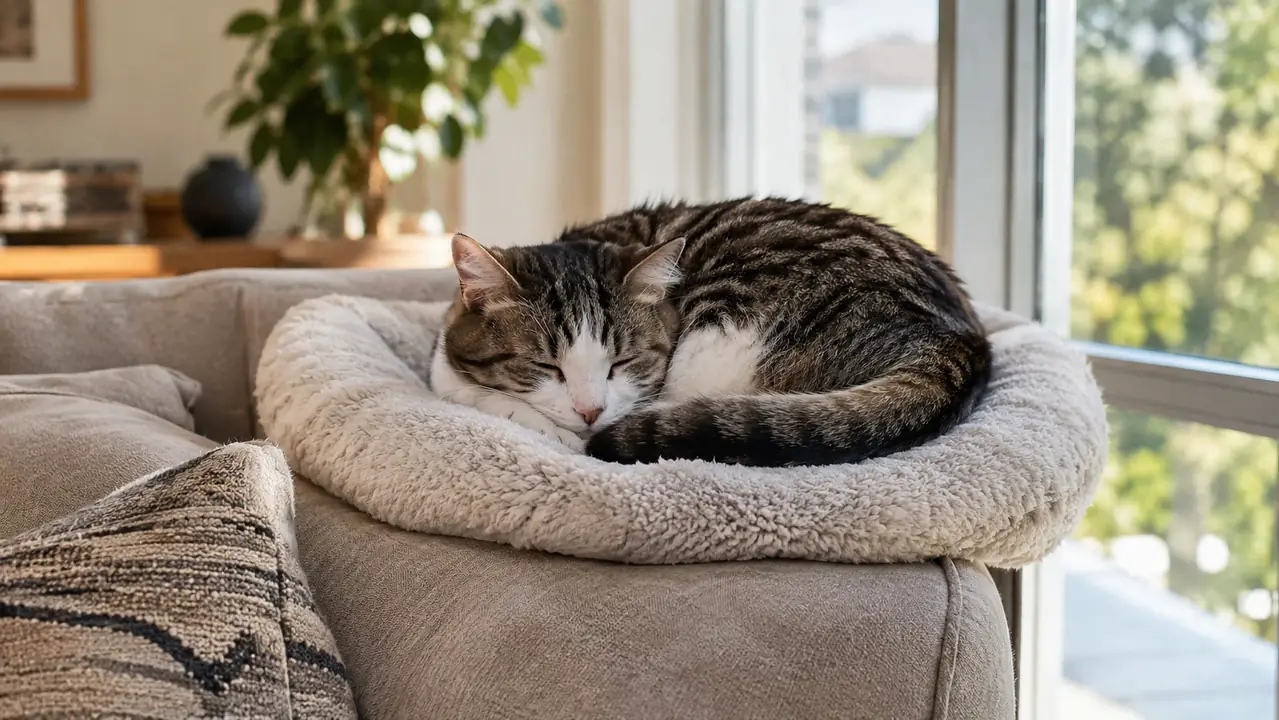
The first sign was the thump. Pepper, our 14-year-old gray shorthair, used to land on the bed like it was nothing. She would gather herself, judge the distance, and sail up in one easy motion. Then one night she jumped, missed, and spent the rest of the evening on the floor looking embarrassed. Our vet said arthritis in her back and hips, which matched everything we were seeing. She stopped jumping onto the bed, then the couch, then she started sleeping in odd spots on the tile floor where the sun came through the living-room window, because the warm patch felt better than any cold bed. Watching her choose the floor over her own beds was the clue that changed how I set things up.
That was about a year ago. What finally worked was a warm sleeping spot she could walk into without jumping, and the K&H Pet Products Self-Warming Cat Bed Pad is the piece that made it stick. No cords, no plug, no electricity. The pad uses a plush material that captures her body heat and radiates it back to her. It sounds like a small thing. For a stiff old cat, it is not. This is how I set it up, what I would do differently, and what actually helped, written the way I would tell you across the kitchen table. I am not a vet, so please check with yours before you change anything about your cat's care. What I can give you is one owner's honest experience, including the parts that took me longer to figure out than they should have.
The pad that ended the cold-tile naps
If you have an older cat that has stopped jumping, this is the pad I set up in about two minutes. It is small at 21 x 17 inches, machine washable, and needs no electricity.
Amazon Check Today's Price on Amazon →Step 1: Put the pad where your cat already sleeps
Before buying anything, I watched where Pepper actually slept. Not where I wanted her to sleep, where she chose. For weeks that was the couch end near the living-room window, because the afternoon sun warmed that cushion and the couch is low enough for her to step onto without jumping. So that is where the pad went. It sounds obvious, but most of the cat beds we had bought over the years sat in corners she never visited once. The expensive one with the raised rim sat in the guest room for a year. The lesson stuck with me.
Do the same for your cat. If they nap on the floor by the heater vent, start there. If they like the foot of your bed but cannot jump up anymore, the spot needs to move lower, not higher. Match the bed to the cat, not the other way around. A beautiful bed in the wrong place is just a decoration, and a decoration does not keep a stiff old cat off the cold floor.
The other thing I learned is that cats with arthritis are creatures of habit. Pepper had already decided where she felt safe. Working with that decision instead of overriding it is the difference between a bed that gets used and a bed that gathers dust. Watch for a week, then place the pad. That week of watching saves you a month of wondering why the cat will not use the new bed.
Measure the spot before you order. The pad is 21 by 17 inches, which is smaller than you might think, and it fits neatly on a standard couch cushion. I checked the space first so the pad would not hang over an edge or crowd the armrest. A pad that fits the spot is a pad that stays where you put it.
Step 2: Choose a pad that warms without a cord
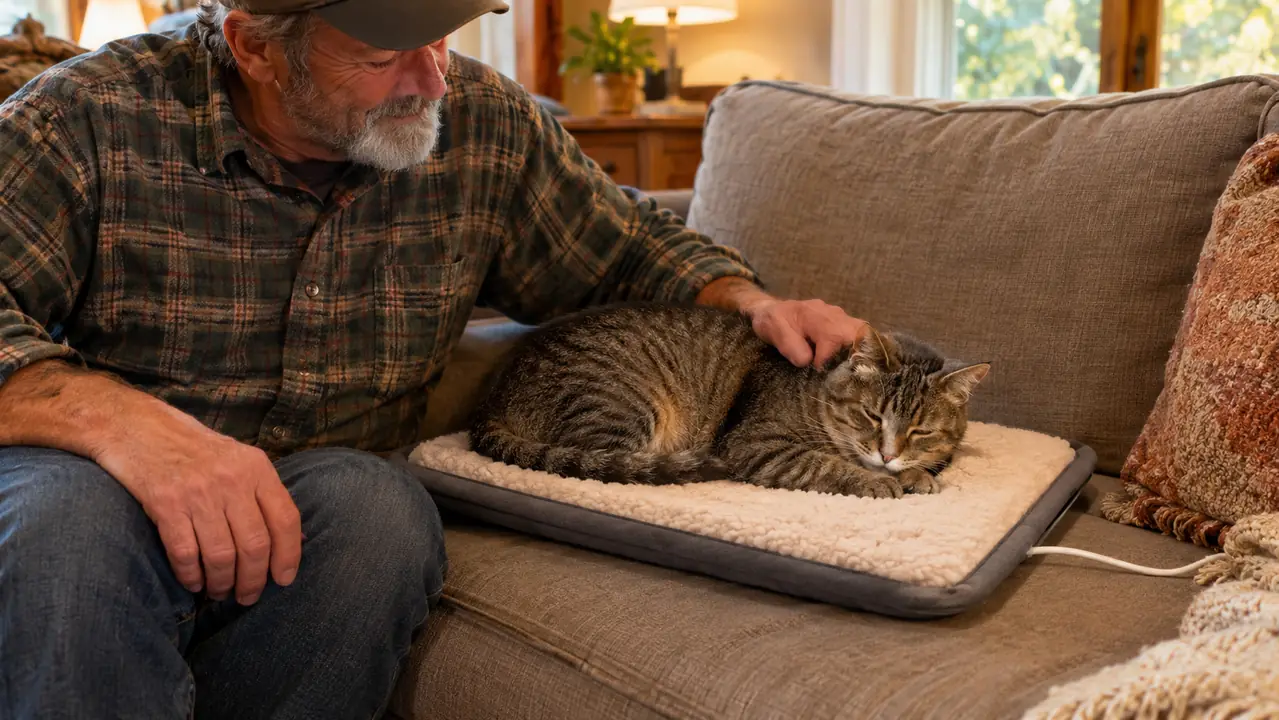
For an arthritic cat, warmth is the point. Stiff joints loosen up a little when the body is warm, which is why Pepper kept hunting for sun patches. I wanted that warmth without an electric cord she could tangle in or chew, and without a heating element I had to remember to switch on and off. The K&H Pet Products Self-Warming Cat Bed Pad does it with material instead of electricity. The plush surface captures her body heat and radiates it back to her. There is nothing to plug in, so there is nothing to forget, and nothing for an unsteady old cat to trip over.
The numbers matter here. It is 21 x 17 inches, about an inch thick, and the weight recommendation tops out at 20 pounds. Pepper is a 10-pound cat, so she is well inside that. The small size is right for a cat who wants to curl into a ball rather than stretch out, and the pad is light enough at 10.24 ounces that I can move it for cleaning without a struggle. The breed recommendation says small, and I would agree. A bigger pad would not have been better, just harder to fit on the couch end she had already chosen.
It is also machine washable, which I care about more than I used to, and it comes with a one-year limited manufacturer warranty. Read the care instructions before the first wash, not after the third one. I say that from experience with other beds we have owned, and from ruining one nice cover by guessing at the settings.
Step 3: Keep it low and level
The whole point of this setup is that your cat never has to jump. Arthritis in the back and hips makes landing the worst part, which is why Pepper stopped using the bed and the couch in the first place. Keep the pad on something low, a couch cushion, a sturdy bench, or the floor. If it has to be higher, give the cat a ramp or stairs wide enough to walk up comfortably. The goal is a spot the cat can walk into, not leap into.
We have a set of low stairs beside our bed that our dog Biscuit uses, and Pepper uses them too when she wants up. Cats will use stairs if the steps are shallow and the surface is not slippery. Tile floors are a hazard on their own, especially in a house like ours in Mesa where the tile runs wall to wall. Put a rug or mat under the setup if the pad sits on tile, so the cat does not have to step onto cold, slick flooring to reach it. That one change, a rug under the pad, made Pepper much more willing to settle in.
And keep it level. The pad is an inch thick, so it is not going to tip, but do not prop it against a cushion at an angle. A flat, stable surface is what a stiff cat wants. If the pad slides on the couch, a thin non-slip mat underneath fixes that without changing the height. Small adjustments like that are the difference between a spot the cat trusts and a spot the cat circles twice and walks away from.
Think about how your cat gets down as well as how they get up. Jumping down is often harder for arthritic hips than jumping up, because the landing takes the full shock. A low spot solves both directions at once. Pepper steps off the couch like a cat half her age now, because she does not have to launch herself anywhere.
Step 4: Make the spot a habit
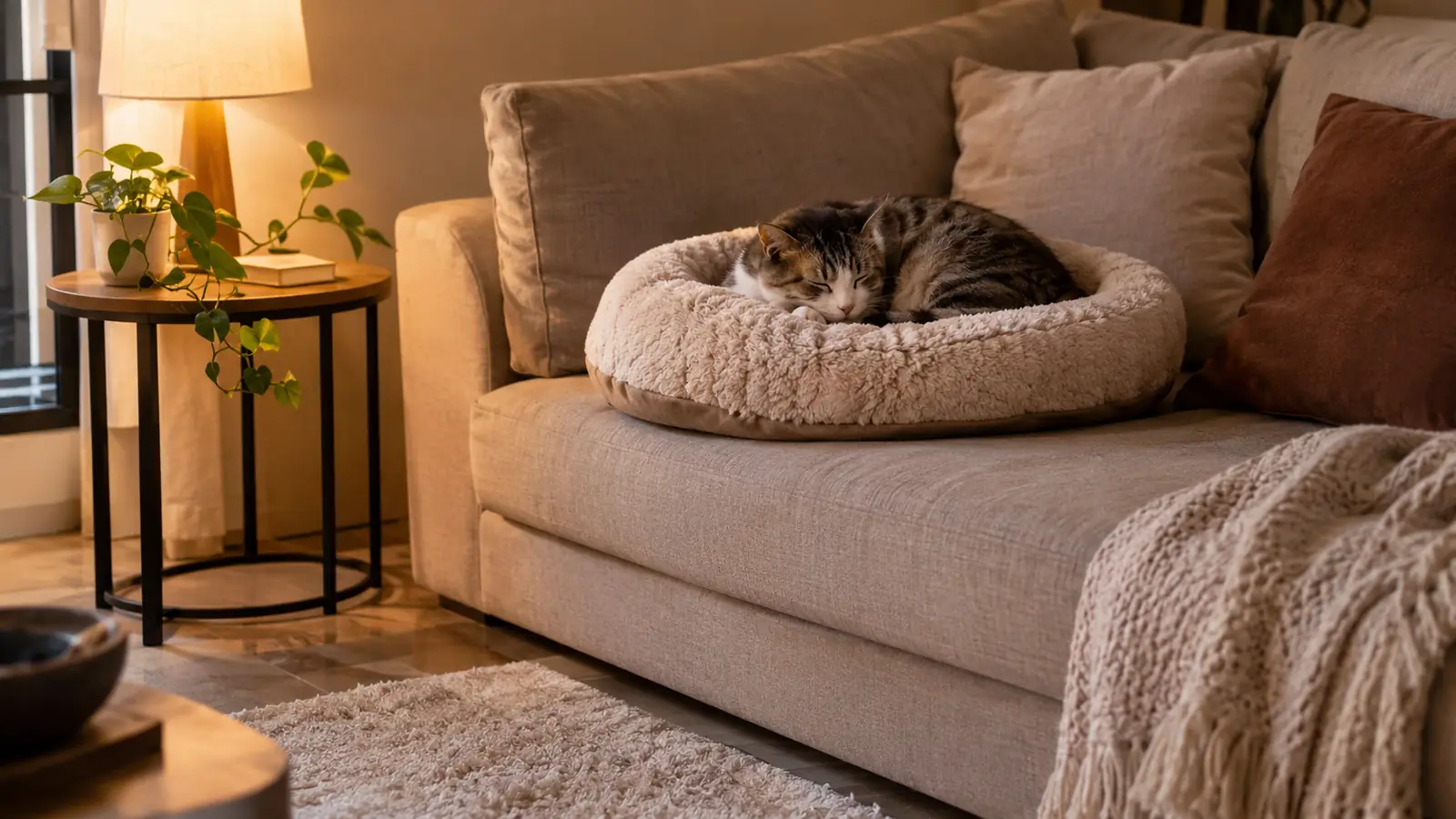
Cats with arthritis do best on a routine, and Pepper is proof. The first few days she sniffed the pad and walked past it. Then I put a treat on it once, and after that she started curling up there on her own. Now she naps on it most afternoons, usually with the afternoon sun coming through the window behind her. That combination, warmth from the pad and warmth from the sun, is what she kept choosing. I did not have to train her. I just had to give her a warm, low place and then leave it alone.
Do not move the pad around to follow the sun or the laundry cycle. Pick the spot, leave it there, and let the cat build the habit. If your cat is hesitant, put a worn t-shirt of yours on top for a day or two. Familiar smell does more than any lure I have tried, and it costs nothing.
Warmth plus predictability. That combination is what turned a pad into her spot, and it is the same reason she stopped sleeping on the cold tile. Once a cat learns where the warm place is, they will go back to it on their own. The pad does not need to be the newest thing in the room. It just needs to be there, every day, in the same place.
At night I leave a small light on in the living room so she can find the pad without fumbling in the dark. Cats see better than we do in low light, but an old cat with stiff joints would rather not navigate in the dark at all. It is a tiny thing, and it is part of why the spot became her spot.
Step 5: Wash it on a schedule and check the seams
This is the part I do not see in most setup guides, and it matters. The pad is machine washable, but it is only useful if it stays clean and intact. I wash it every couple of weeks on a gentle cycle and air dry it, following the care instructions that came with it. A clean pad is also a pad that keeps its loft, and loft is what traps the body heat. Once the plush gets matted down, the self-warming effect fades, and the cat notices before you do.
I sew, so I check the seams and the fabric every time it comes out of the wash. A worn spot or a loose seam is how a pad stops being comfortable, and for a cat with arthritis, comfort is the whole job. The one-year limited manufacturer warranty from K&H Pet Products covers defects, but regular checks are on me. If the pad ever stops laying flat or the plush gets matted, I will replace it rather than hope it fixes itself. A tired pad is not worth the fight.
A clean, flat, warm pad is one an old cat will actually use. A matted, smelly one will be ignored, and then you are back to square one, with the cat sleeping on the cold tile again. Ten minutes of maintenance keeps that from happening.
One more note on washing: I use a mild detergent and skip the dryer completely. The care instructions matter, and air drying keeps the plush from crushing. If you have ever ruined a good fleece jacket in the dryer, you know exactly what I mean.
What Else Helps
The pad is one piece of the puzzle. Pepper has been getting Cosequin sprinkle capsules on her wet food for about eighteen months, after our vet suggested them when she first stopped jumping. I cannot tell you how much of her improvement is the supplement and how much is the warm bed and the lower furniture, because I am not a vet and I did not run a study. I can tell you she gets around better than she did a year ago, and I would not stop either part of the routine. The warm bed made the biggest visible difference in her daily habits; the supplement is the part I would not skip on the advice of our vet.
Other things that helped: keeping her nails trimmed so she does not catch them trying to climb, putting a rug on the coldest stretch of tile, raising her food and water bowls slightly so she does not have to crouch, and keeping play gentle and short. When she has a stiff day, I let her rest. Old cats earn the quiet days, and forcing movement on a painful joint never helped anybody. I learned that the hard way with our dog Biscuit, who has his own joint trouble and taught me to read the signs of a bad day early.
Warmth is the part people overlook. The K&H Pet Products pad does the job without electricity, which means it is safe to leave out all day and all night, and there is nothing to forget to turn off. For an old cat, steady warmth beats a blast of heat that comes and goes. That steady warmth is also why Pepper stopped circling and started settling.
Talk to your vet about pain management and supplements. What worked for Pepper may not be right for your cat, and your vet is the one who knows your cat's history. I will say this much: the warm, low, predictable bed was the change that got Pepper back to napping in the living room instead of on the cold floor. That is a result I can see every single afternoon.
Pepper naps on this pad most afternoons. For a cat who had stopped using every bed we bought her, that is the whole review.
Give your stiff old cat a warm place to land
Set this pad up in two minutes, wash it on the weekend, and let your cat decide. Ours voted with her nap schedule.
Amazon Check Today's Price on Amazon →