
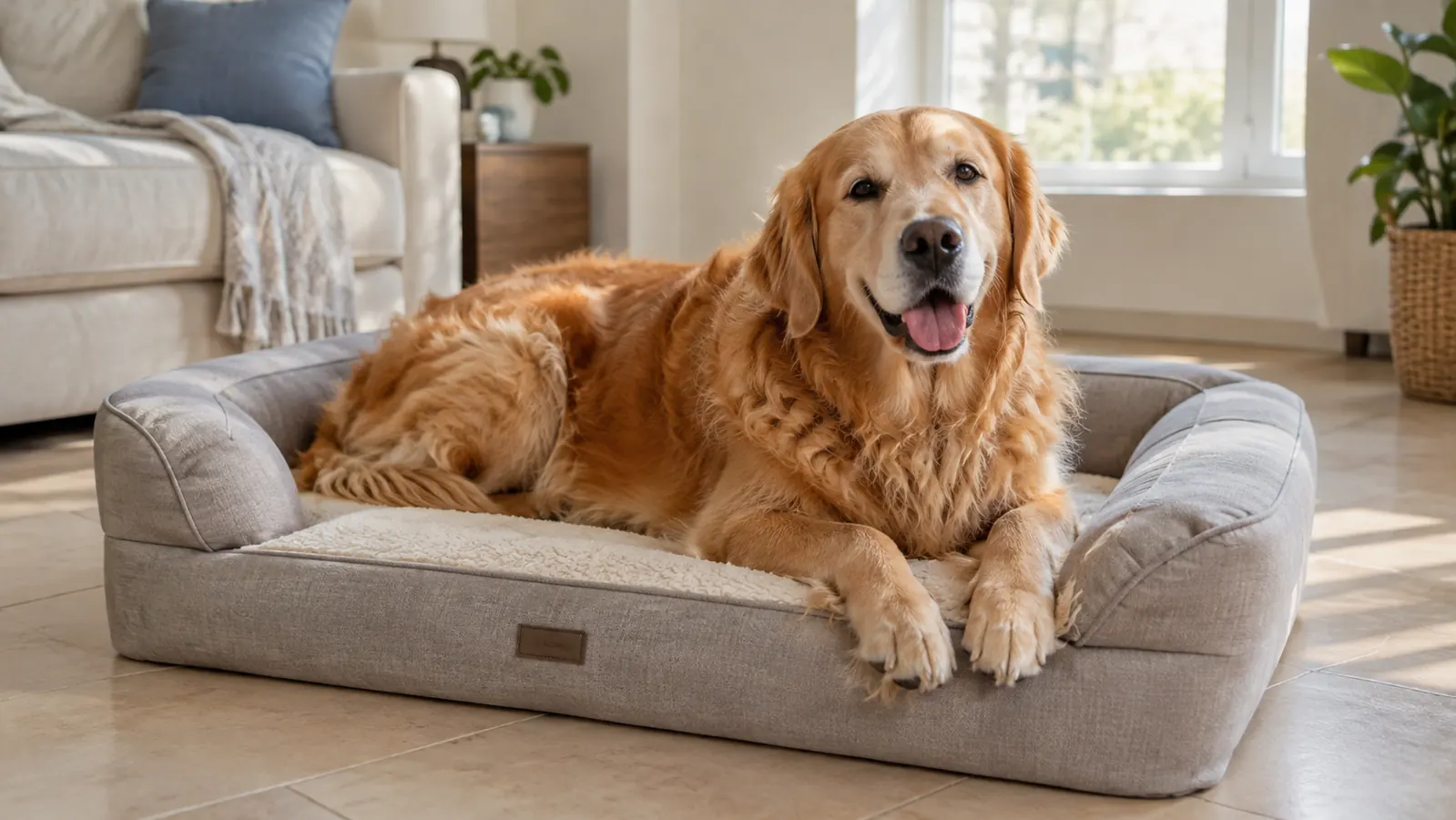
The first time Biscuit tried to climb onto his old bed, he stood over it for a full minute, front paws up, back legs refusing to cooperate. He is an 11-year-old, 62-pound yellow Lab mix with hip dysplasia, and his back legs are stiffest first thing in the morning and after long walks. That flat, cheap pillow bed had gone pancake-flat years ago, and it gave him nothing to push against. I knew we needed something better, but I had no idea how much thought goes into a dog bed when your dog's hips are the reason you are shopping.
I am not a vet, and I want to be clear about that up front. I am a retired school office manager in Mesa, Arizona, who has spent eighteen months learning what helps a dog with hip dysplasia sleep better. I sew in my spare time, so I tend to notice stitching, fabric, and seams that other people might miss. This guide is what I wish someone had handed me before I started shopping: the five steps I used to choose the Bedsure orthopedic dog bed for Biscuit, and the questions I would ask about any bed you are considering.
The bed that finally got my dog comfortable: the Bedsure orthopedic dog bed
After eighteen months of testing, this is the bed Biscuit actually sleeps on every night. If you want to skip straight to the bed that worked for us, check today's price on Amazon.
Amazon Check Today's Price on Amazon →Step 1: Measure your dog, not the room
The biggest mistake I made with Biscuit's first bed was buying one that looked right in the store but was too small for him to stretch out. A dog with hip dysplasia does not curl up tightly the way a healthy young dog does. He needs to lie flat, with his hips and back legs fully supported, and that means the bed needs to be longer than he is from nose to base of tail, with room to spare. The old bed had barely 30 inches of usable space once the stuffing flattened, so his hips hung off the back edge no matter how he arranged himself. I wrote his measurement on a sticky note and taped it to my phone, because I knew I would forget it in the store.
Biscuit is 62 pounds, and the Bedsure orthopedic dog bed in large is 35 x 7 x 25 inches. I measured him nose to base of tail with a cloth tape measure one Saturday morning and got 34 inches, so the large gives him room to stretch out with his head on the edge and his hips fully on the foam. That measurement is the only reason I did not come home with a medium. If your dog is bigger than Biscuit, measure nose to base of tail and add six inches. If you are between sizes, go up. A bed that is too small is worse than no bed at all, because your dog will end up with his hips hanging off the edge.
One more measurement matters: the height of the bed. Biscuit's bed is 7 inches tall, which is high enough to give him a little cushion when he lowers himself down, but low enough that he does not have to climb. If your dog has very weak back legs, you may want to pair the bed with a set of pet stairs or a ramp, which I will talk about in the last step.
Step 2: Look for real orthopedic support, not just a thick pillow
Here is where I got fooled the first time. A thick, fluffy bed feels soft to your hand, but a dog with hip dysplasia needs something firmer. The foam needs to support the hip joint so it does not sink into a hole, which is exactly what happens with a pillow bed that has gone flat. Biscuit's old bed was so soft that his hips basically rested on the floor through the fabric.
The Bedsure bed uses CertiPUR-US certified foam, which means the foam itself is made without certain harmful chemicals and meets third-party standards for emissions. That mattered to me because Biscuit sleeps on this bed for eight or nine hours a night, and I did not want him breathing in anything questionable. The foam is firm enough to support his hips, but not so hard that he avoids the bed. He settled onto it the first night, which is more than I can say for the two beds we tried before it.
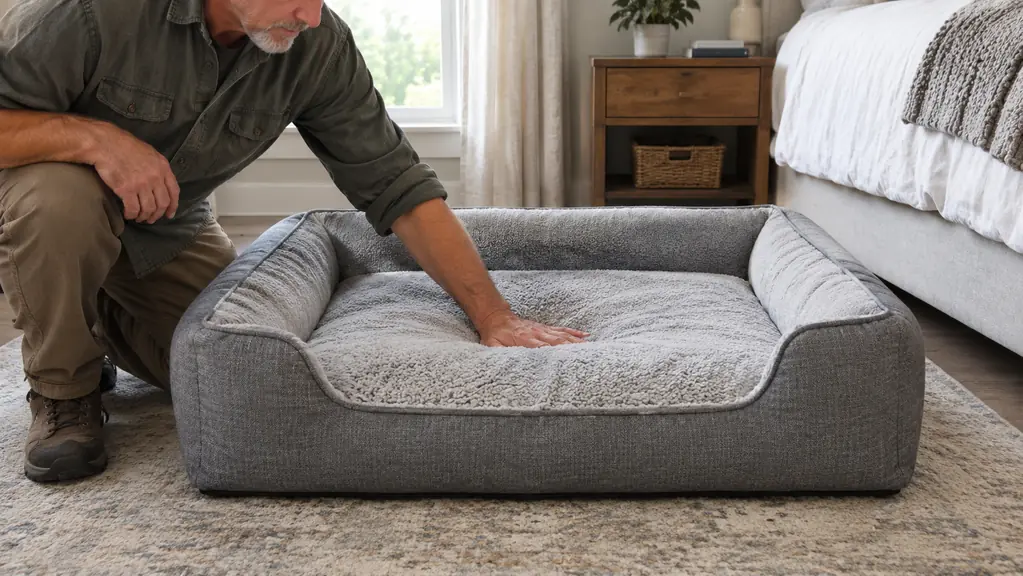
When you are shopping, press your hand into the center of the bed. If your hand sinks all the way to the floor, the foam is too soft. You want a bed where your hand makes a shallow dent and the foam springs back. That is the difference between a bed that supports a sore hip and a bed that just looks comfortable. The first bed we tried was a round, fluffy donut-style bed from a big-box store, and Biscuit avoided it entirely, choosing the cold tile over the cushion. The second was a flat foam pad that felt firm in the box but dented permanently within a month, right where his hip sits. I could press my hand into that dent and touch the floor through the fabric. That is when I stopped feeling fabric and started reading foam certifications.
Step 3: Check the cover, the seams, and how it actually washes
I sew, so I will confess that this is the step I care about most. A bed cover takes a beating from claws, from dogs who circle before lying down, and from the occasional accident when an older dog cannot hold it overnight. The Bedsure bed has a removable cover, which is the single most important feature for me. I sewed a spare cover for Biscuit's bed so one is always clean and dry while the other is in the wash.
The bed is listed as easy to clean, waterproof, and with a removable cover. That combination means I do not have to scrub the whole bed when Biscuit has a bad night. I unzip the cover, toss it in the washing machine, and put the spare on while the first one dries. If you do not sew, a removable cover is still worth paying extra for. A bed you cannot wash is a bed you will replace in a year, and an older dog with hip dysplasia will have accidents no matter how careful they are.
Look at the zipper, too. A cheap zipper will fail after a dozen washes, and then you are stuck with a cover you cannot remove. The zipper on Biscuit's Bedsure cover has held up through months of weekly washing, which is more than I can say for the throwaway bed we had before. The first time he had an accident on the old bed, I spent an hour scrubbing the whole thing in the bathtub, and it still smelled like it had never been washed. With the Bedsure, I unzip the cover, toss it in with a load of towels, and wipe the waterproof liner underneath with a rag in about two minutes. I sewed the spare cover from the same quilted fabric so it feels identical to him, and I keep it folded on the shelf next to his leash.
Step 4: Consider the bolsters and how your dog actually sleeps
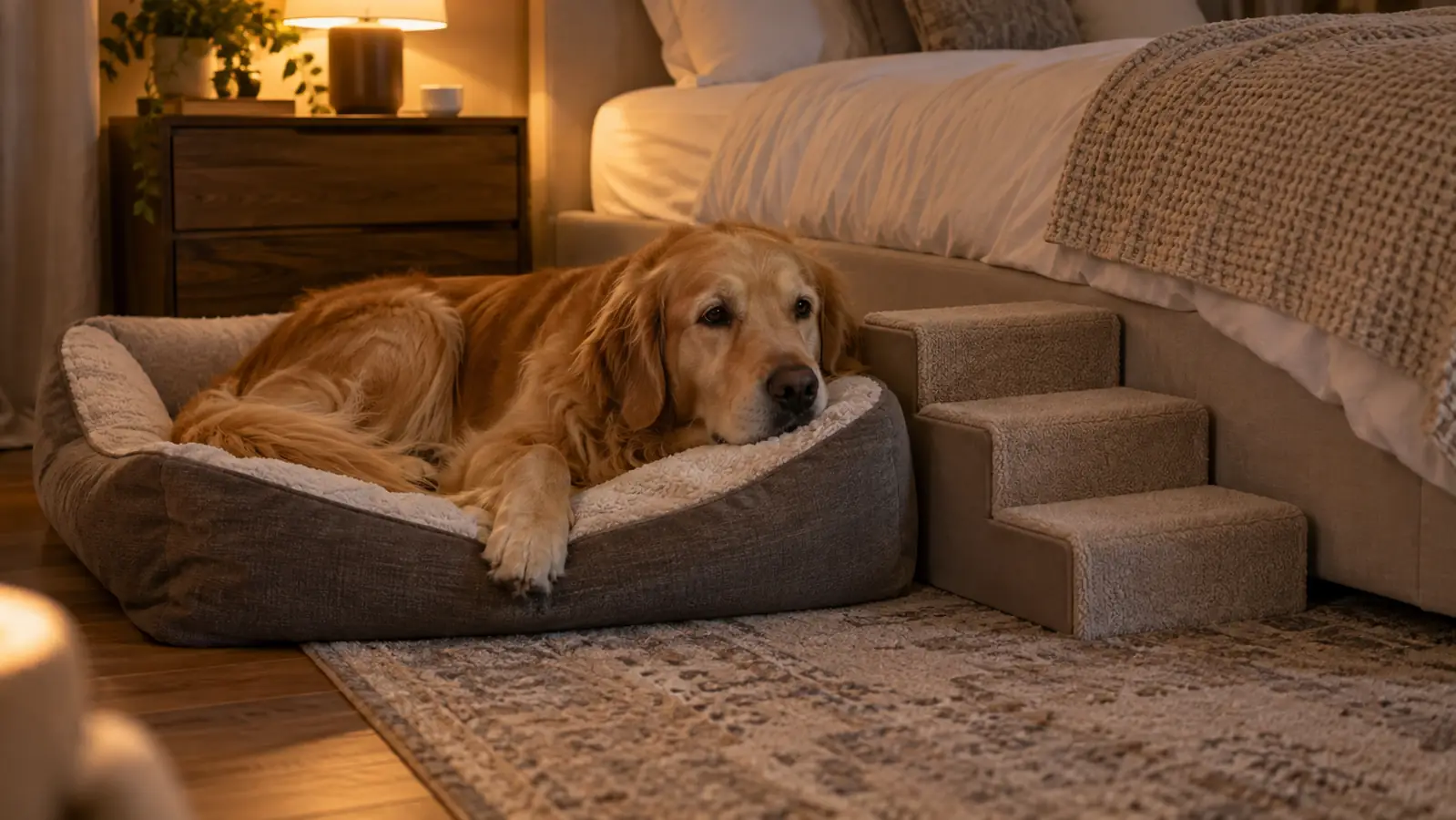
Biscuit is a leaner. He likes to rest his head on something, and he also likes to feel enclosed when he sleeps. The Bedsure bed has a 4-sided bolster design, which means there is a raised edge on all four sides of the bed. That gives him a place to rest his head and a sense of security that a flat bed never provided.
For a dog with hip dysplasia, the bolsters do something even more important: they give the dog something to brace against when he is getting up. Biscuit uses the front bolster to push himself upright in the morning, and he can do it without yelping. That was not true with the flat bed, where he had to scramble on the floor to get any leverage.
Some dogs prefer to sleep stretched out flat with no bolster at all, and if that is your dog, a bolster bed might not be right. But for a dog who likes to lean, or who needs help getting up, a bed with bolsters on all four sides is worth seeking out. The 4-sided design is one of the reasons I chose the Bedsure over the cheaper flat beds we tried. One morning last January, I watched him brace his front paws on the front bolster, push once, and stand. It took two tries, but he did not cry out, and he did not slip on the tile. On the flat bed, he used to roll onto his side and rock back and forth like a turtle before he could get his back legs underneath him. That contrast is the whole argument for the 4-sided design.
Step 5: Think about the floor, the location, and how your dog gets in and out
We live in a single-story house in Mesa with tile floors, and tile is hard on a dog with hip dysplasia. The Bedsure bed is 7 inches of foam, which lifts Biscuit off the cold, hard tile and gives his hips a layer of cushion between him and the floor. If you have hardwood or tile, a thicker bed matters more than if you have thick carpet.
Location matters too. Biscuit's bed is in our bedroom, where he sleeps at night. Pepper, our 14-year-old gray shorthair, has her own self-warming pad on the couch, so they do not fight over beds. If you have multiple pets, you may need more than one bed, and you will want to put them in the places your pets actually sleep, not just where they look nice.
Finally, think about how your dog gets in and out of the bed. Biscuit can step onto a 7-inch bed without help, but he cannot jump onto the human bed anymore. We bought a set of 18-inch, 4-step dog stairs about a year ago, after he misjudged a jump up and yelped. He uses the stairs to get onto our bed, and Pepper uses them too. If your dog struggles to step up even 7 inches, look for a lower bed, a ramp, or a set of stairs to pair with it.
What Else Helps
A good bed is only part of the picture for a dog with hip dysplasia. Biscuit has taken Nutramax Cosequin chewable tablets daily for about two years, since our vet confirmed the hip dysplasia on X-rays when he was nine. Pepper gets the sprinkle version on her wet food. The bed helps him rest, but the supplement and the vet's advice are what manage the joint itself. Talk to your vet before adding anything to your dog's routine, especially if your dog is on other medication.
The day I realized the bed mattered most was the morning Biscuit pushed himself up using the bolster instead of yelping and scrambling on the tile. That was the day I stopped second-guessing the purchase.
Other things that helped us: keeping Biscuit's nails trimmed so he does not slip on the tile, putting a nonslip mat under the bed so it does not slide when he steps on the edge, and keeping the bed out of direct sun so the foam does not break down as fast. None of these are as important as the bed itself, but they all add up to a dog who sleeps through the night instead of shifting and whining.
If your dog's hips are stiff, start here
Pick a bed with firm, CertiPUR-US certified foam, a removable waterproof cover, and bolsters your dog can brace against. That is exactly what the Bedsure orthopedic dog bed gives Biscuit. Check today's price on Amazon and see if it is the right size for your dog.
Amazon Check Today's Price on Amazon →