
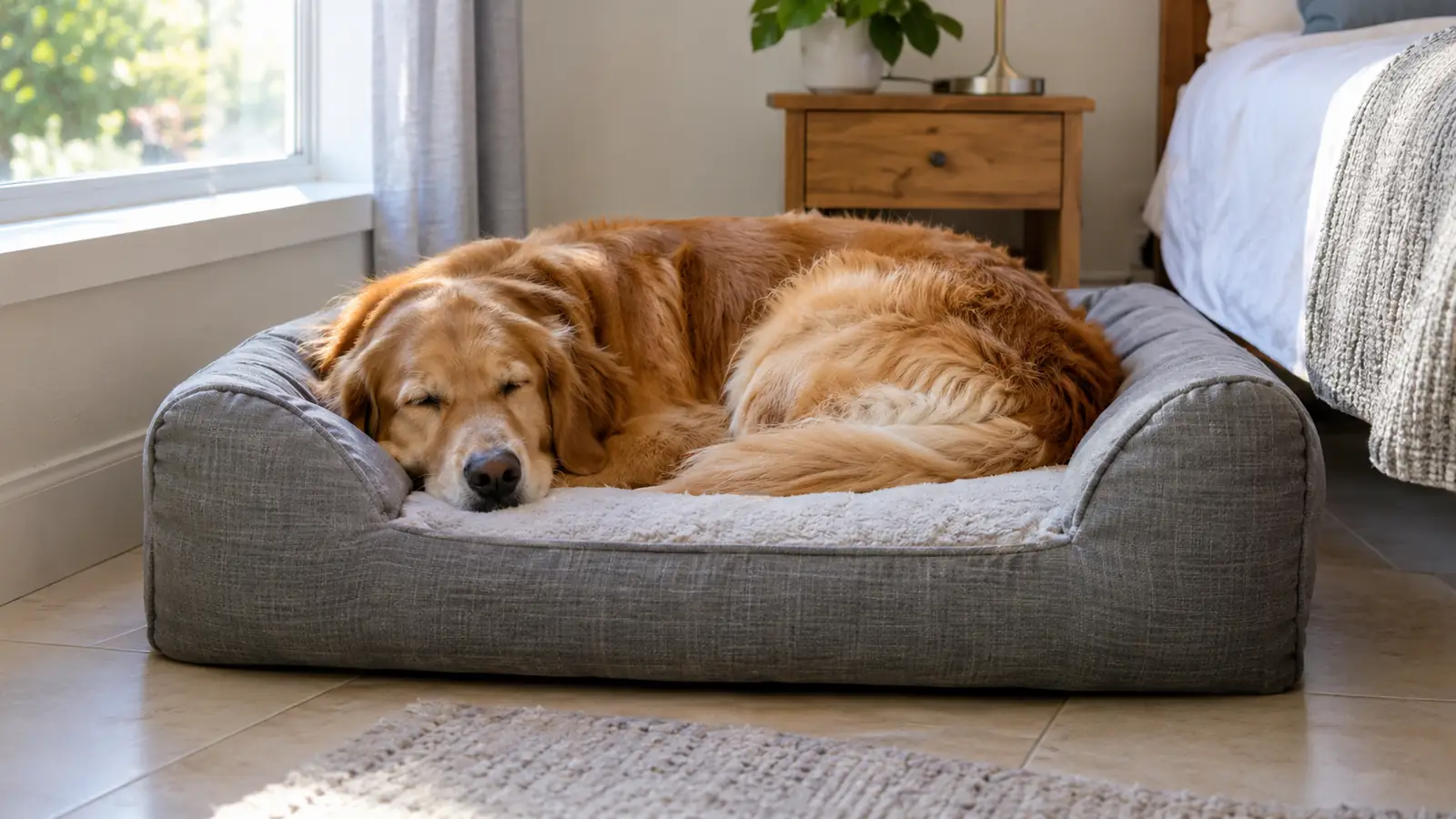
If your dog is anything like mine, you have watched the same small heartbreak play out every morning. Biscuit is an 11-year-old, 62-pound yellow Lab mix with hip dysplasia and stiff back legs. He used to bound off his bed the second he heard my coffee mug. Lately he lies there a beat longer, front legs first, back end last, and I can see the exact moment his hips decide whether today is a good day. We live in Mesa, Arizona, in a single-story house with tile floors everywhere, which means every joint in his body lands on something hard. For the last eighteen months, that landing has been a Bedsure orthopedic dog bed, and I have strong opinions about it.
The Quick Verdict
The Bedsure orthopedic dog bed is the rare bed that fixes the real problem: hard floors under a stiff senior dog. The foam is firm enough to support, the bolsters give Biscuit somewhere to rest his head, and the removable waterproof cover has survived eighteen months of washing. It is not a memory-foam cloud, and the 30-pound weight recommendation means big-dog owners should size up. I would buy it again tomorrow.
Amazon Check Today's Price →A stiff senior dog deserves better than a pancake-flat pillow bed
Eighteen months in, this is the bed I would put under any large dog with creaky hips. See today's price on Amazon before you decide.
Amazon Check Today's Price on Amazon →How I've Used It
I bought this bed about eighteen months ago, when Biscuit was nine and our vet had just confirmed hip dysplasia on X-rays. The bed it replaced was a flat, cheap pillow bed that had gone pancake-flat after about a year. I remember the exact morning I gave up on it. Biscuit circled it three times, pawed at the middle, and flopped down with his hip bone basically on the tile. He let out a grunt, the kind of sound he only makes when something actually hurts, and I stood there watching him for a full minute before I said out loud, 'That's it.' I spent the next two weeks reading orthopedic bed listings the way other people read menus, comparing foam thickness and bolster heights and cover zippers until my eyes crossed. The Bedsure kept coming up in reviews from owners of big dogs with old joints, so I ordered the large size and waited for the box like a kid waiting for a birthday. When it arrived, I unpacked it in the living room and let it sit flat on the floor for a few hours so the foam could relax into shape. Biscuit inspected it the way he inspects everything new, one slow circle, one suspicious sniff, and then he climbed on and lay down like he had owned it for years.
The Bedsure bed lives in our bedroom, against the wall on my side, on tile. Biscuit uses it every single night and for most of his daytime naps. I bought the large size, which is the one Amazon lists for large breeds. The listed dimensions are 35 x 7 x 25 inches and it weighs about 5.34 pounds, so it is easy for me to lift and move when I sweep. I also learned quickly that one cover is not enough when a dog with hip dysplasia has the occasional accident.
One note on the weight recommendation: the listing says the maximum weight recommendation is 30 pounds. That number confused me at first, because Biscuit is 62 pounds and this bed is clearly built for large dogs. I read it as a note about the foam density rather than a hard limit, and our experience backs that up. Biscuit has slept on it nightly for eighteen months and the foam still holds its shape. If your dog is much heavier than mine, I would still size up and read the listing carefully.
What the Foam Actually Feels Like
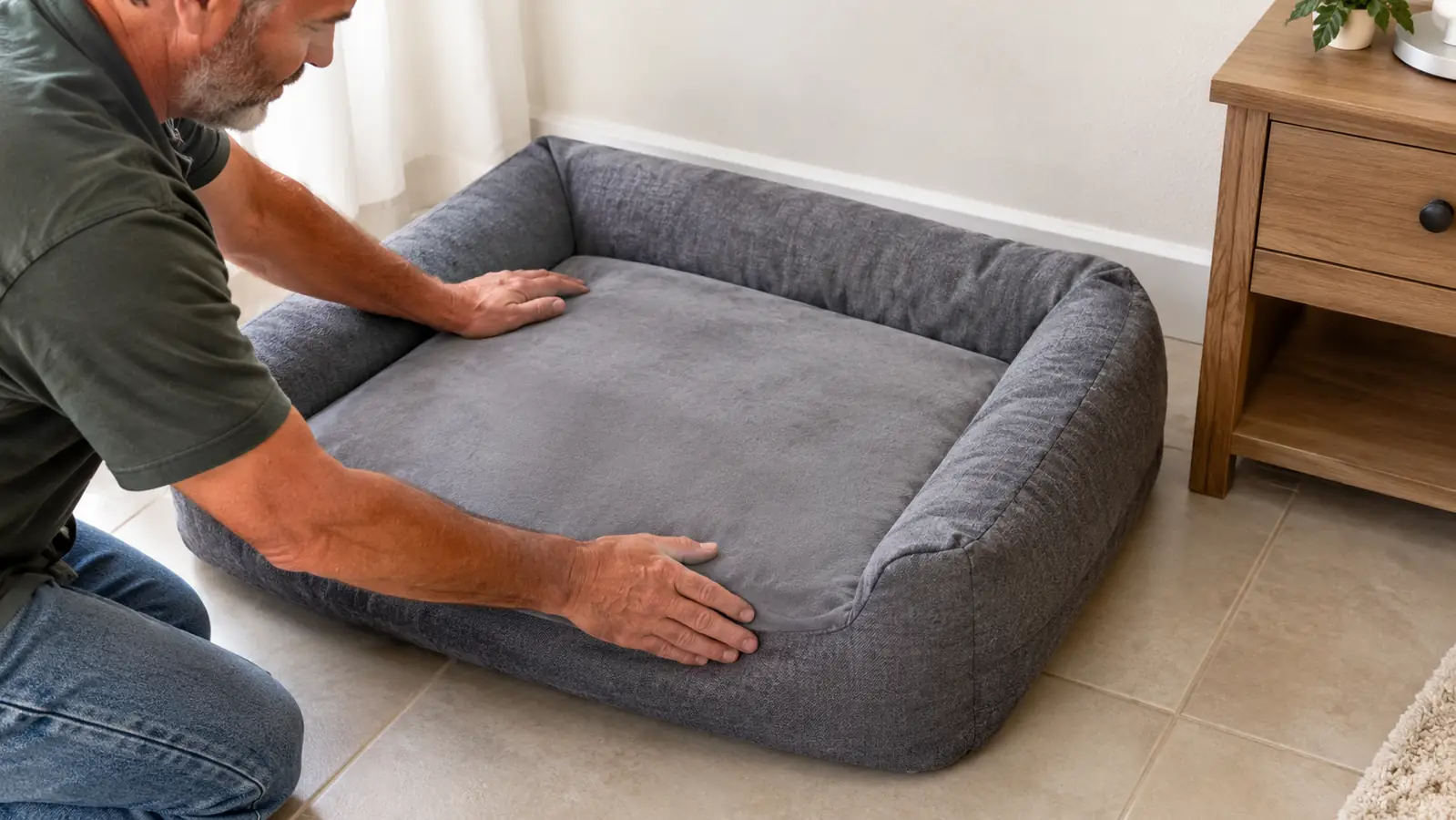
Let me be precise, because this is the part every listing gets vague about. The Bedsure bed uses CertiPUR-US certified foam, and you can feel the difference between it and the cheap pillow bed it replaced the moment your hand touches it. When Biscuit first stepped onto it, he did that little shift-and-settle dance dogs do when a surface finally gives. He turned around twice, pawed once at the bolster, and folded himself down with a sigh I had not heard him make in months. The foam is firm, not squishy. It supports his hips instead of swallowing them. I tested it myself the way I test a mattress in a store: I pressed my palm into the middle, then knelt on it with one knee to see how far it gave. It gives maybe an inch under my weight and then stops. That is exactly the feel I wanted for a 62-pound dog with stiff back legs. The first morning after he slept on it, he got up with noticeably less hesitation than usual. Not a cure, not even close, but enough that I noticed it before my coffee was done. He still takes a beat to get going, but he does not brace himself the way he used to, and that small change is why I stopped second-guessing the purchase.
The bed is also listed as standard 100 by OEKO-TEX certified, which means the materials were tested for harmful substances. I am not a chemist and I am not a vet, but I am a person who puts her face directly into dog beds when she changes the covers, and I appreciate knowing the foam and fabric passed an independent standard. The listing also calls the materials pet safe, which matches what I have seen: no strong chemical smell out of the box, no off-gassing that bothered Biscuit or me.
The one thing this bed is not is a plush memory-foam mattress. If you press your hand into it, it does not hold a handprint and slowly spring back. It is orthopedic support, which means it keeps the dog's body in a neutral position rather than letting it sink. For a dog with hip dysplasia, I have come to believe that firm support is the point. Sinking feels nice for five minutes and then the joints are working against the foam to get back up.
The foam is firm, not squishy. It supports his hips instead of swallowing them. That is the whole job, and eighteen months in, it still does it.
The Bolster Design, the Cover, and the Tile Floor Test
The 4-sided bolster design is the feature I did not expect to matter as much as it does. Biscuit is a dog who likes to rest his head on something when he sleeps, and the raised bolsters on all four sides give him a pillow no matter which way he curls. The listing says the design promotes comfort and security, and I can see it in how he settles. He tucks his nose against the bolster, lets out a sigh, and is out. That sigh is my favorite sound in the house.
The cover is where I have strong opinions as someone who sews. It is removable, which is non-negotiable in my house, and the listing lists it as waterproof and easy to clean. I have washed it more times than I can count in eighteen months, and it has held up better than covers on beds that cost twice as much. The zipper still runs smoothly, and that is the first thing I check on any cover, because a zipper that snags is a cover you stop using. The fabric has not pilled or thinned where Biscuit's elbows land. About six months in, I sewed a spare cover in a heavy cotton duck fabric I had left over from another project. I copied the shape of the original, cut the panels, and put in the same kind of zipper. It took me an afternoon, and I am not a fast sewer. Now I swap covers every Sunday morning, wash the dirty one on the gentle cycle, and let it air dry over the back of a chair. The whole swap takes two minutes, and that one habit is the difference between a bed that stays fresh and a bed that gets thrown out. If you do not sew, buy a second cover when you buy the bed. You will want it.
The tile floor test is the one I did not plan. We have tile in every room, and a bed that slides, skids, or pancakes is a bed that fails. This one stays put. The base grips the tile well enough that Biscuit can step on and off without the whole bed scooting across the floor. That matters more than you think when a dog with stiff back legs is trying to get his footing. The listed product dimensions are 35 x 7 x 25 inches, and the 7-inch profile is low enough for him to step onto without a hop, which is exactly what his hips need. I have watched him miss the edge with one back foot more than once, and the bed does not slide out from under him. A bed that slides is a bed that a stiff dog stops using, and this one has never slid.
How It Has Held Up Over Eighteen Months
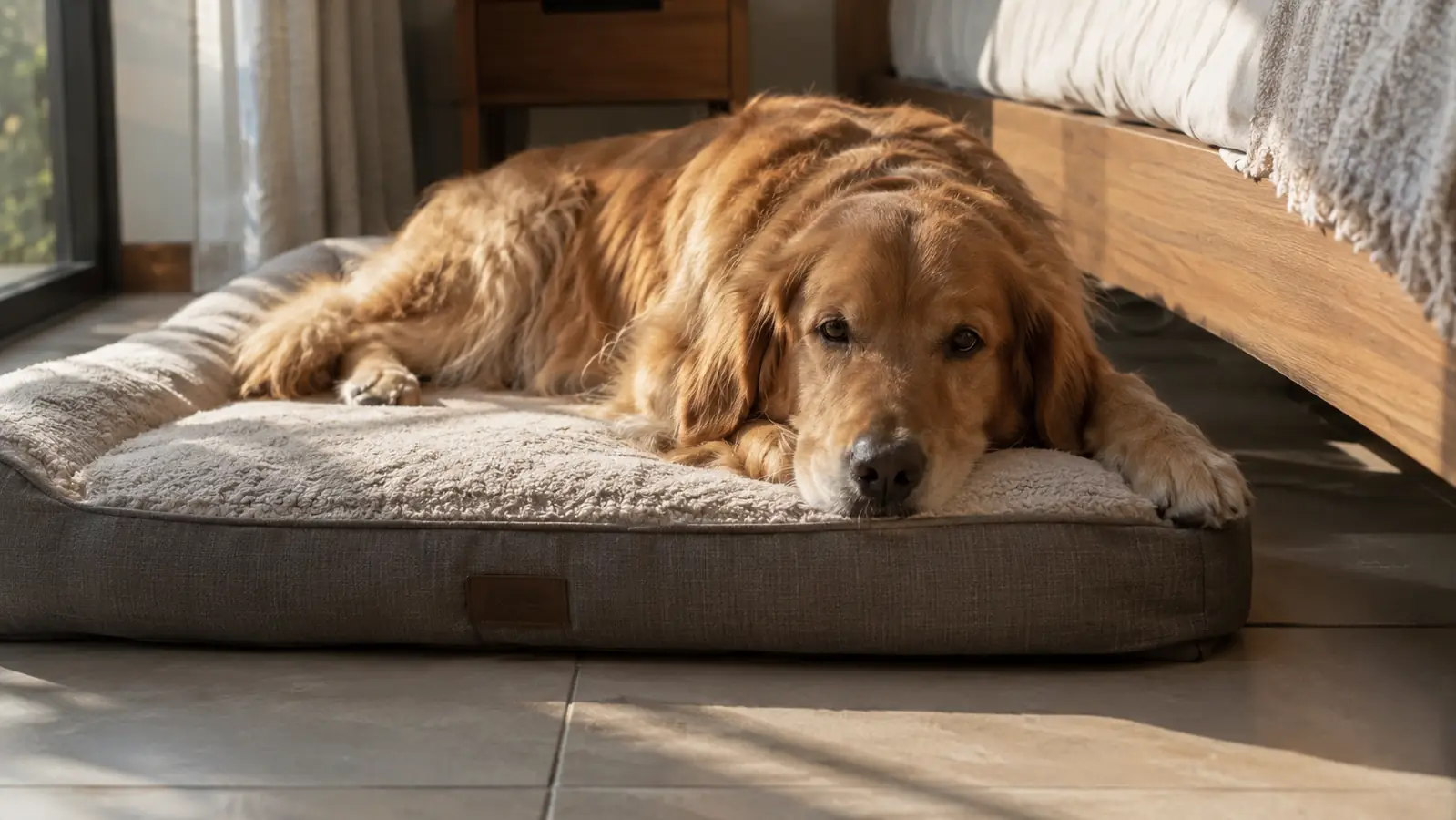
Here is the honest part. After eighteen months of nightly use, the foam has compressed slightly where Biscuit's hips land, but not flat. When I strip the cover off, I can see a shallow dip maybe a quarter of an inch deep, and it springs back most of the way when I flip the bed over. He still gets the support he needs, and the bed still looks presentable when I put the clean cover on. The stitching around the bolsters has held, even though Biscuit rests his chin on the same spot every single night. The zipper has held. There was one rough patch last winter, after a long walk, when Biscuit had an accident on the bed at three in the morning. I caught it within the hour, stripped the cover, washed it, and the foam underneath was completely dry and clean. That one incident paid for the waterproof cover all by itself. I have not had to replace the bed, and I have not wanted to. My mother, who watches Biscuit when we travel, asked about the bed the last time she stayed over, because she could see how easily he got on and off it. That is the kind of compliment that counts.
What has not been perfect: the cover, while waterproof, is not indestructible, and a dog with hip dysplasia will occasionally have accidents. I caught one early, washed the cover, and the foam underneath was fine. If you leave a wet spot sitting, no cover in this price range is going to save the foam. I also wish the cover came in more than one piece, because washing the whole thing is a bit of a workout. Those are small complaints against the alternative, which is a dog sleeping on tile.
I should also say plainly that a bed is not a treatment. Biscuit takes Nutramax Cosequin chewable tablets daily, started after our vet confirmed his hip dysplasia when he was nine, and that combination of supplement, the bed, and the EHEYCIGA stairs I bought after he misjudged a jump has kept him comfortable. The bed is one part of his comfort, not the whole answer. If your dog is stiff, talk to your vet. I am not one, and I do not pretend to be.
What I Liked
- Firm CertiPUR-US certified foam supports a 62-pound dog without letting him sink to the floor
- 4-sided bolsters give a stiff senior dog somewhere to rest his head no matter which way he curls
- Removable, waterproof cover has survived eighteen months of regular washing without pilling or snagging
- Low 7-inch profile is easy for stiff back legs to step onto, and the bed stays put on tile
- At about 5.34 pounds, it is easy to lift and move when I sweep the bedroom
Where It Falls Short
- The 30-pound maximum weight recommendation is confusing on a bed sized for large breeds, so read the listing carefully
- Firm orthopedic foam is not a plush memory-foam feel, and some dogs take a few nights to adjust
- Washing the cover means washing the whole cover, so a spare is worth having
- Not built for determined chewers; no cover in this price range survives that
Who This Is For
This bed is for anyone with a large dog who sleeps on hard floors and deserves better than a flat pillow. It is for the owner who has watched their senior dog circle a bed, paw at it, and flop down anyway. It is for the person who wants orthopedic support without paying boutique prices, and who is willing to wash a cover on a regular basis. If your dog is stiff first thing in the morning, or after long walks, or if you have tile, wood, or laminate floors, this bed is a genuinely useful upgrade. The CertiPUR-US certified foam, the 4-sided bolsters, and the removable waterproof cover all pull in the same direction: a firm, clean, supportive place for a creaky dog to rest.
Who Should Skip It
Skip this bed if you want a plush, sink-into-it memory foam feel; this foam is firm, and that firmness is the point. Skip it if your dog is a heavy chewer who destroys beds, because no cover in this price range survives determined chewing. Skip it if you are not willing to wash the cover, because a waterproof cover only helps if you actually clean it. And read the size and weight recommendations carefully before you buy. The listing says the maximum weight recommendation is 30 pounds, which I read as a note about the foam, but if you have a very heavy dog, I would size up and check the current listing details. If your dog is small, buy the size that matches your dog, not the size I bought.
The bed that ended the pancake-flat problem in our house
Eighteen months of tile floors, hip dysplasia, and washing cycles, and this is still the bed Biscuit chooses every single night. Check today's price on Amazon.
Amazon Check Today's Price on Amazon →