
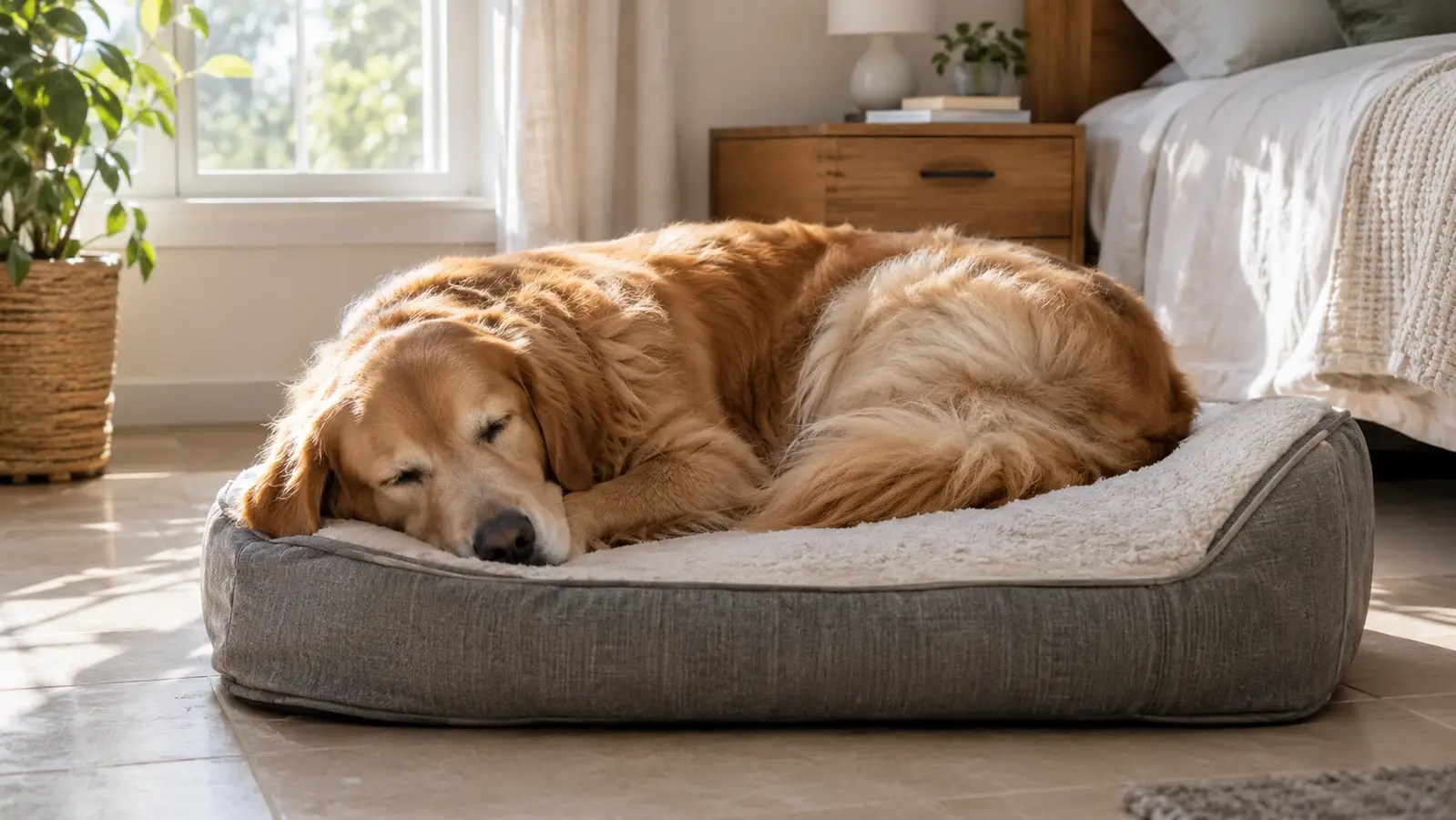
I have sewn long enough to know that most things fall apart at the seams, and that is exactly where I looked first when the Bedsure orthopedic dog bed showed up for Biscuit. He is an 11-year-old, 62-pound yellow Lab mix with hip dysplasia and stiff back legs, and his old pillow bed had gone pancake-flat in under a year. I wanted a bed that would not quit, and I wanted to see the stitching hold up to a dog who flops down hard after every walk. Eighteen months later, I have opinions, and a few of them are not the ones you will find in the listing.
The Quick Verdict
A genuinely well-built orthopedic bed for the price, with a removable cover that survives real washing. It is not a cure for hip dysplasia, and the 30-pound weight limit in the specs is confusing for a bed marketed to large dogs. Buy it for the build quality, not for magic.
Amazon Check Today's Price →The bed that has held up to 18 months of a heavy dog flopping onto it
If you are tired of replacing flat, flimsy dog beds, this is the one I keep buying. Check today's price on Amazon and see the current options.
Amazon Check Today's Price on Amazon →How I Have Used It
Biscuit's Bedsure bed has lived in our bedroom for about eighteen months, in the same corner where his old pillow bed used to sit. He is on it every night, plus a couple of daytime naps, and he does not get on it gently. He circles, he flops, he digs at the corner with his front paws before he lies down, and in the mornings he sometimes just drops from a standing position straight onto the foam. That is the test that kills cheap beds, and it is the test the Bedsure has passed.
The first night, I put the bed down at about 9:15, and Biscuit did what he always does with something new: he sniffed the whole edge, circled twice, and flopped down with his back legs folded under him. I remember checking the foam the next morning to see if it had kept its shape, because his old bed had a Biscuit-shaped hollow by the end of the first month. The Bedsure did not. The listing gives the size as 35 by 25 inches, and the whole bed is about 7 inches tall at the bolsters. It weighs 5.34 pounds, so I can pick it up one-handed when I vacuum around it. That matters in a house with tile floors, because I sweep under everything once a week.
I also sewed a spare cover for it within the first month, because I knew a washable cover would not stay washable if I let the original get ruined. My spare is not as nice as the one Bedsure made, but it fits, which tells you the cover is cut to a real pattern rather than gathered and hoped into place. A bed cover that fits after being washed and sewn back on is a small thing, and it is also the thing that separates a bed built by people who understand fabric from a bed built by people who just want a photo.
Pepper, our 14-year-old gray shorthair, has claimed the corner of it on cold afternoons, even though it is Biscuit's bed. She weighs 10 pounds, so she does not test the foam the way he does, but she does test the cover when she kneads before settling. The fabric has held up to that too, which surprised me, because her claws are sharp and she has put a few snags in other beds.
After the first month, I stopped thinking about the bed at all, which is the highest compliment I can give a piece of pet gear. The old pillow bed needed fluffing every morning; this one does not. I do not flip it, I do not rotate it, and I do not punch the foam back into place. Once a week I vacuum the cover, and every couple of months I wash it. That is the whole maintenance routine, and it is why the bed still looks as good at eighteen months as it did at six.
The bed sits in its corner a few feet from the stairs he uses to get up and down. In the mornings he climbs down using the stairs, crosses the short stretch of tile to the Bedsure, and lies down while I make coffee. On days when his hips are stiff, he will sometimes stand at the edge of the bed and look at it before he commits, and when he finally lies down, he lets out a sigh. I have learned to read that sigh as relief, and it happens more often on this bed than it ever did on the old one.
What Nobody Tells You About the Foam
The listing talks about orthopedic support, and the foam is genuinely firm. Biscuit is 62 pounds, and when he lies down the foam holds its shape under him instead of swallowing him the way his old pillow bed did. He sinks in just enough to feel cradled, and when he gets up, the foam springs back. I have pressed my hand into it many times, and I have never felt it go soft or develop a permanent hollow.
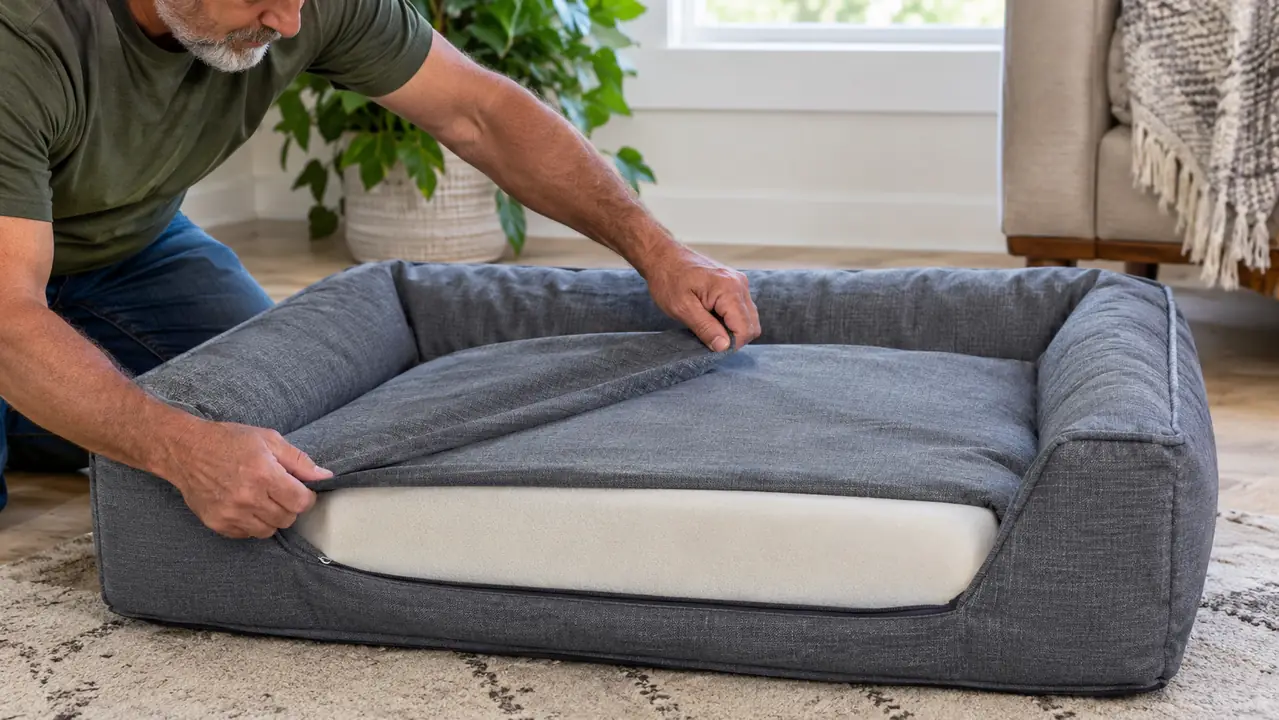
One afternoon I took the cover all the way off to look at the foam itself, the way I would look at a piece of fabric before I bought it. It is a solid slab, not a thin pad wrapped around something hollow, and it has a dense, even feel from one end to the other. The listing says the foam is CertiPUR-US certified and the bed is OEKO-TEX certified, and after eighteen months I believe it, because the bed never smelled like chemicals. I am sensitive to that. I once had to air out a cat cave for a week before Pepper would go near it, and this bed had no smell at all on day one.
Here is what nobody tells you: the foam is not magic, and it will not fix a stiff back leg. Biscuit still moves slowly first thing in the morning, and he still needs a little help getting up after a long nap. The bed makes him more comfortable while he is lying down, and it gives him a stable surface to push against when he stands, but it does not replace the things our vet recommended for his hip dysplasia. If you are buying this bed hoping it will cure your dog's joints, you will be disappointed. If you are buying it so your dog has a supportive place to rest, you will not.
The specs say the maximum weight recommendation is 30 pounds, which I found genuinely confusing for a bed that also says it is for large dogs. Biscuit is 62 pounds, more than double that number, and the bed has held up fine for eighteen months. I am not a vet and I am not an engineer, but I can tell you what I saw: a large dog on a large bed, no sagging, no collapsed corners, no complaints. I would still mention the weight limit to your vet if your dog is heavy and has joint issues, because I do not want anyone to read my experience as medical advice.
The morning test is the one I trust most. Biscuit's back legs are stiffest when he first gets up, and on the old pillow bed he used to rock forward twice before he could stand. On the Bedsure, he still moves slowly, but he plants his front feet, pushes off the firm surface, and gets up in one motion more often than not. I have watched him do this hundreds of times, and the difference is the surface, not the dog. A soft bed gives him nothing to push against; this one gives him something.
What I Liked
- Genuinely firm orthopedic foam that has held its shape for eighteen months under a 62-pound dog
- Removable cover with a real zipper and finished seams that survives regular washing
- 4-sided bolsters give Biscuit a place to rest his head and have not flattened
- CertiPUR-US certified foam and OEKO-TEX certified materials, with no chemical smell out of the box
- Lightweight enough at 5.34 pounds to move one-handed when I clean
Where It Falls Short
- The 30-pound maximum weight recommendation in the specs is confusing for a bed marketed to large dogs
- The cover is awkward to put back on until you get the hang of it
- Raised bolsters get in the way if your dog likes to stretch out completely flat
- Not built for chewers; the foam and bolsters will not survive teeth
- It supports comfort but does not treat hip dysplasia or arthritis, so manage your expectations
The Stitching, From Someone Who Actually Sews
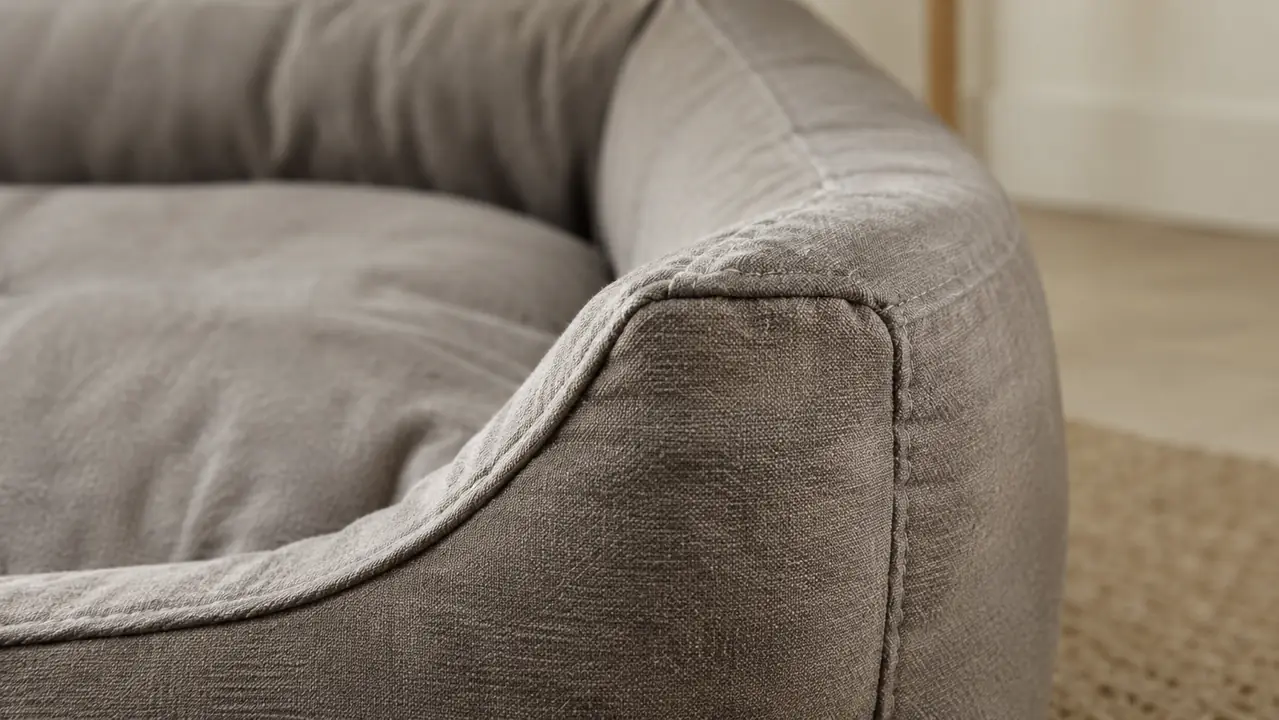
I checked the seams the day the bed arrived, the way I check any fabric thing that enters my house. The stitching along the top edge is even, the corners are reinforced, and the zipper on the cover is a real zipper, not a decorative one that splits the first time you use it. I have washed the original cover a dozen times and my spare cover at least as many, and no seam has pulled, no thread has snapped, and no edge has frayed. For a bed that costs what this bed costs, that is remarkable.
When I turned the cover inside out to copy the pattern for my spare, I found the seam allowances are finished, not raw. That means the fabric will not unravel in the wash, and it tells me someone thought about how the bed would be laundered, not just how it would look in a photo. The zipper is sewn in straight, with the teeth stopping at the end of the opening, so the cover lies flat when it is closed. I have sewn enough zippers to know how easy it is to get one slightly off, and this one is not.
The 4-sided bolster design is the other thing I want to talk about, because it is the reason Biscuit sleeps with his head propped on the raised edge. The bolsters are firm enough to hold their shape but soft enough that he rests his chin on them, and they have not flattened the way the edges of his old pillow bed did. When I sewed my spare cover, I had to measure around those bolsters, and I will tell you honestly that it was not the easiest cover I have ever made. The shape is more complicated than a flat rectangle, and that complication is exactly what makes the bed worth having.
Eighteen months of a 62-pound dog flopping onto this bed, and the seams still look like the day I unpacked it. That is the part the photos cannot show you.
I should also say something about the zipper pull, because it is the first thing to fail on a lot of covers. Ours is still attached, still slides smoothly, and has never caught the fabric when I close it. I have had zippers on other pet beds fail within months, and I have replaced more than one with a new zipper from my sewing basket. I have not had to do that here.
Washing It Without Ruining It
The cover is removable and machine washable, and I have tested that claim harder than most people will. Biscuit has had a couple of accidents on the bed, and the cover has been through the wash with enzyme cleaner, regular detergent, and once by accident with a load of towels. It came out clean every time, and it went back on the bed without a fight. The waterproof layer under the cover has done its job too: the foam has never smelled, never stained, and never needed anything but fresh air.
My washing routine is simple: cold water, gentle cycle, a capful of enzyme cleaner, and line dry. I do not put the cover in the dryer, because I have seen what heat does to zippers and to waterproof backing, and I would rather wait a day than shrink the cover. It has been through the wash at least a dozen times in eighteen months, and it still fits the foam the same way it did the first week.
One honest note: the cover is not fitted like a sheet. It is more like a big pillowcase with a zipper, and you have to wrestle the foam back in the right way or the bed looks lopsided. I have done it enough times that I can do it in about two minutes now, but the first time, I stood there wondering if I had bought the wrong size. Give yourself one practice run before you need to do it in a hurry.
The waterproof layer is not a separate liner you can pull out. It is part of the cover, so you wash the whole thing together and there is no extra piece to lose. I know this because I looked for a liner when I sewed my spare, and there was not one to copy. My spare is plain cotton duck, which means it is not waterproof, so I save it for the weeks when the original is drying. That arrangement has worked well: the original cover does the wet jobs, and the spare keeps the bed from looking empty.
If you hate laundry, this bed will not change that, because the cover has to come off and go back on, and the first few times that is a two-handed job. What it will save you is the bigger job of replacing a ruined bed. I would rather spend two minutes wrestling a cover than spend an afternoon shopping for a new bed because the old one smelled or stained. That trade has worked out in my favor every single time.
Who This Is For
This bed is for someone who is tired of replacing cheap dog beds, and for a dog who likes to rest their head on a raised edge. It is for a dog who flops down hard, because the foam holds up. It is for an owner who wants a removable, washable cover, because the zipper and the stitching will survive real laundering. And it is for someone who understands that a bed is part of a bigger picture: Biscuit also takes the joint supplement our vet recommended, and he uses a set of stairs to get onto our bed, and all of those things together are what keep him comfortable.
Who Should Skip It
Skip this bed if your dog is a chewer, because the bolsters and the foam are not built to survive teeth. Skip it if you need a bed that is truly flat, because the raised bolsters are the whole point and they get in the way of a dog who likes to stretch out completely flat. And if your dog is well over the 30-pound weight recommendation in the specs, talk to your vet before you buy, the way I wish I had. Biscuit has done fine at 62 pounds, but I am one household, not a guarantee.
Still deciding? This is the bed I would buy again tomorrow
After eighteen months, the Bedsure bed is the one Biscuit chooses every single night. See today's price on Amazon and decide for yourself.
Amazon Check Today's Price on Amazon →