
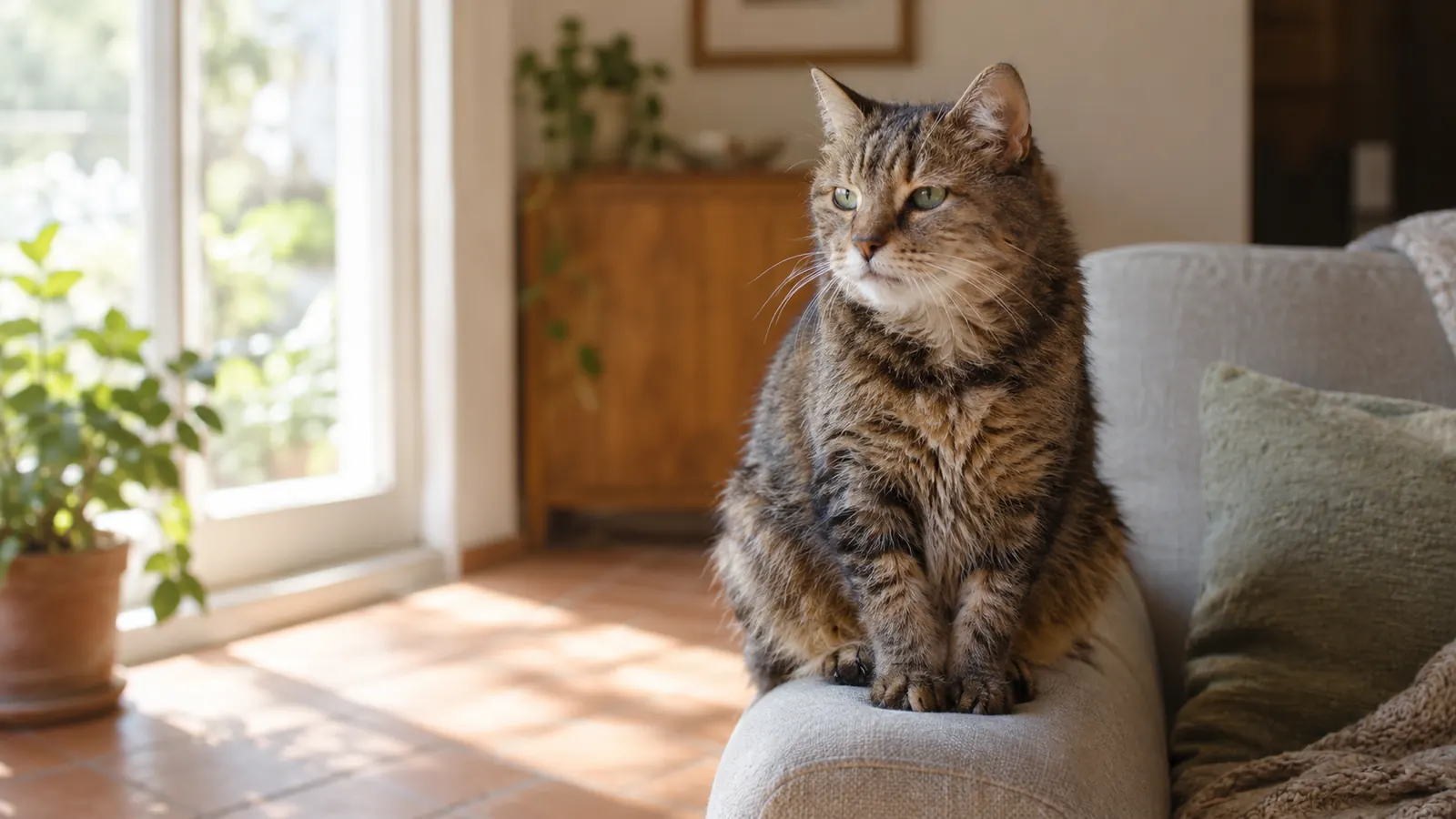
The first thing I noticed was the jump. Pepper is our 14-year-old gray shorthair, 10 pounds on a good day, and she had spent the better part of a year staring at the couch instead of getting on it. She would put her front paws up, think about it, and step back down. The bed was worse. She stopped trying altogether. Our vet said arthritis in her back and hips, and that it was common in a cat her age, and that a joint supplement was worth trying. She also said to be patient, that supplements are slow, and that if Pepper had not improved in two months we would talk about other options. That is how Cosequin Animal Care sprinkle capsules ended up in my kitchen cabinet.
Eighteen months later, I can tell you exactly what changed and what did not. I am not a vet and I am not a scientist. I am a retired school office manager in Mesa, Arizona, who has spent a lot of mornings on the kitchen floor watching an old cat eat her breakfast. I kept notes in a spiral notebook for the first few months, dates and small observations, because I did not trust my memory with something this gradual. The notebook is still in the drawer, and I still flip through it when I wonder whether the capsules are worth reordering. This is that story, with the specific details I wish someone had given me before I started.
The Quick Verdict
It took about six weeks to see a real difference, and the difference was modest but real: Pepper jumps onto the couch again, uses the stairs to the bed, and stopped crying at the foot of the bed at night.
Amazon Check Today's Price →If your cat has stopped jumping, this is the supplement I'd start with
Cosequin Animal Care is the brand our vet suggested, and eighteen months in, I still buy it. The sprinkle capsules mix into wet food in seconds, and the bottle is small enough to tuck into a cabinet.
Amazon Check Today's Price on Amazon →How I've Used It
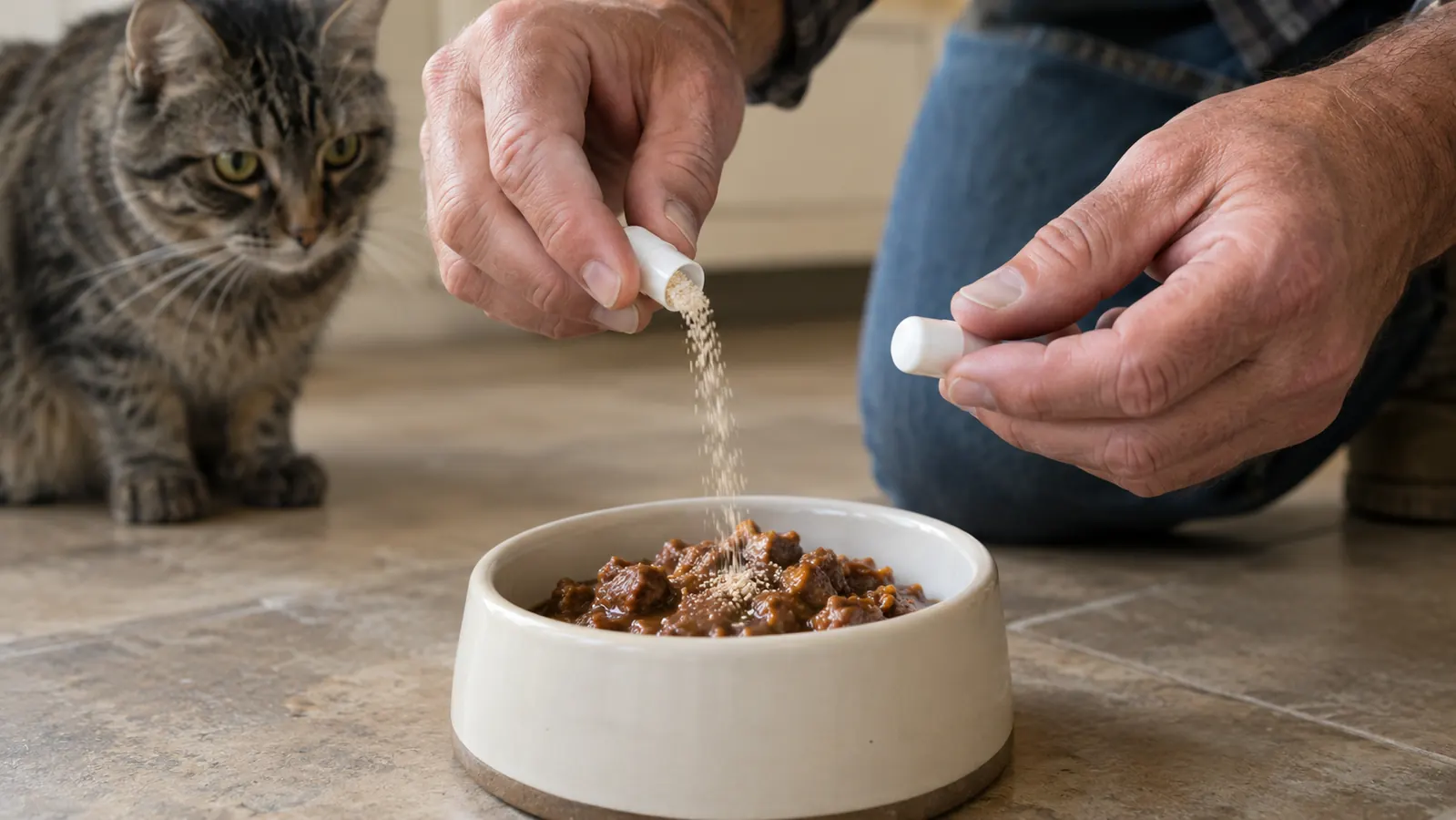
Pepper gets one sprinkle capsule a day, mixed into her wet food. The capsule is small and easy to open, which matters more than you would think at 6:40 in the morning with a cat winding around your ankles. I open it over the bowl, sprinkle the powder evenly, and stir it in with the same teaspoon I use for her food. The listing says the capsules mix easily, and that has been true for us: the powder dissolves into the gravy of the wet food well enough that I have never once seen her leave powder in the bowl.
The first morning I gave it to her, I opened the capsule over her bowl and the powder puffed up in a little cloud. Pepper sniffed it, gave me a look, and ate it anyway. I have learned since that the puff is normal and it settles right into the food, but I remember thinking that first day that I had no idea what I was doing. The capsules are flavored chicken, which helps. Pepper will eat almost anything once, but she notices when something is different about her breakfast, and she has never once refused a meal because of the powder.
I give it to her at the same time every morning, right after I feed Biscuit, our 11-year-old yellow Lab mix, and before I make my own coffee. On mornings when she is slow to the bowl, I mix the capsule into a small spoonful of wet food first so I know she gets the whole thing, then offer the rest of her breakfast after.
One practical note: I keep the bottle in the cabinet above the sink, not on the counter. The capsules are small and easy to knock over, and I learned that the hard way when one rolled under the fridge and I spent ten minutes with a broom handle fishing it out. The 80-count bottle lasts us about two and a half months, which is worth knowing if you are trying to decide whether the price makes sense for your budget. I also wrote the date on the bottle with a marker the first time, so I would know exactly when to reorder.
What Actually Changed
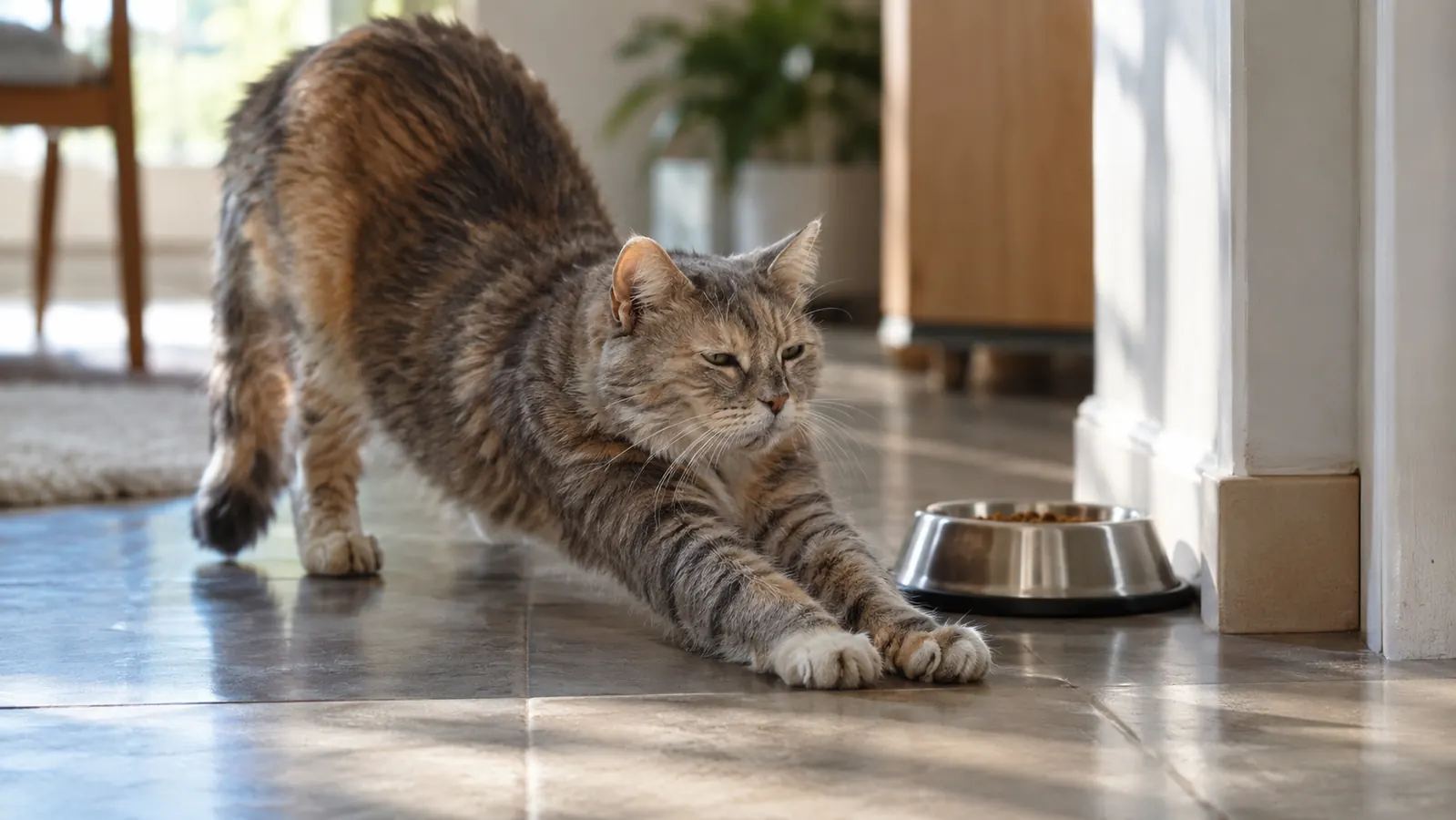
I kept notes in a spiral notebook because I wanted to know if this was working or if I was just hoping. For the first three weeks, honestly, I did not see anything. Pepper still did the front-paws-up, step-back-down dance at the couch, and she still sat at the bottom of the stairs to the bed and yowled. I almost stopped giving it to her. Then around week four, I noticed she was stretching more in the mornings, that long slow full-body stretch cats do, and she was not wincing the way she had been.
The real change came around week six. I was sitting in the living room reading and Pepper got on the couch. Not the end of the couch where the K&H self-warming bed pad is, not the low footstool, the actual couch, from the floor, in one go. She measured the jump, crouched, and went, and she landed a little hard on her front feet, but she was up. I did not move. I just watched her do it, then I watched her do it a second time to be sure I was not imagining it. By month four, she was getting on the couch two or three times a day, usually in the afternoon when the sun comes through the living room window and warms that end of the cushion. It sounds like a small thing, but when a cat has spent a year not jumping, a cat jumping is a big thing.
The bed is a different story. Our bed is high, and Pepper still does not jump up onto it. What she does now is use the EHEYCIGA stairs we bought for Biscuit after he misjudged a jump and yelped. She climbs them slowly, one step at a time, usually right after breakfast when she wants the sunny spot on the bed, and she gets up there most mornings for a nap. The stairs sit beside our bed, and Biscuit uses them every morning too, so they are a busy piece of furniture in this house. Sometimes Pepper waits for him to go first, then follows. Watching a 14-year-old cat and an 11-year-old dog with hip dysplasia use the same stairs in the morning is a strange kind of comfort. Before the supplement, she would not even try the stairs. Now she uses them like she has always used them.
The other change I noticed was at night. Pepper used to cry at the foot of the bed, a low grumbly sound that meant she wanted up but could not make the jump. That stopped somewhere around the two-month mark. I noticed because I had gotten used to sleeping through it, and then one night I realized I had not heard it in over a week. I told our vet about it at Pepper's checkup, and she said that was the kind of change she likes to hear, slow and steady rather than dramatic. She still meows at me in the morning for breakfast, but the frustrated bedtime sound is gone.
What Did Not Change
I want to be honest here because every review I read before starting made it sound like an overnight fix, and it is not. Pepper still has arthritis. She still walks with a slight hitch in her back legs when she first gets up, worst first thing in the morning just like Biscuit's stiff back legs. She still prefers the warm bed pad on the couch to the cold tile floor, and she still takes the stairs slowly instead of bouncing up them like she did when she was five. She also still cannot make the jump onto the bathroom vanity, which she used to do to look out the window. That has not come back, and I do not expect it to.
The supplement did not make her young again. What it did was take the edge off. The difference between a cat who cannot get on the couch and a cat who can is enormous, but the difference between a cat who can and a cat who bounds is also enormous, and we are firmly in the middle. If you are hoping for a cat who acts like a kitten again, I cannot promise you that, because that is not what happened for us.
I also want to be clear about the timeline. It took six weeks. I know some people see results faster, and I know some see them slower. Our vet told me to give it a full two months before judging, and that turned out to be exactly right. If you try this and do not see anything in the first week, that does not mean it is not working. It means you need to be patient and consistent, because a supplement only works if it is in the bowl every single day. What I can tell you is that the change has held. Eighteen months in, she still gets on the couch, she still uses the stairs, and the bedtime crying has not come back. That consistency is the reason I keep buying the capsules.
What I Liked
- Sprinkle capsule format is genuinely easy: open, sprinkle, stir, done. No pilling a cat, no hiding pills in treats.
- Chicken flavor means Pepper has never once refused a meal with the powder mixed in.
- Took about six weeks, but she jumps onto the couch again and uses the stairs to the bed most mornings.
- 80-count bottle lasts about two and a half months, so the daily routine is simple to keep up.
- Brand our vet named without prompting, and Nutramax has made pet supplements for over 25 years.
Where It Falls Short
- It is not fast. We saw no real change for the first three to four weeks, and the full effect took about six.
- It did not fix everything. Pepper still has a hitch in her walk and still cannot make the high jump onto our bed or the bathroom vanity.
- The powder needs wet food to stick to. If your cat eats dry food only, this format will be harder to use.
- It is a daily commitment, and you have to judge it over months, not days.
The difference between a cat who cannot get on the couch and a cat who can is enormous, and that is exactly what changed for us, right around week six.
The Ingredients and the Brand
What is in the capsule matters to me because I am the one who buys it. Each sprinkle capsule has 125 mg of glucosamine hydrochloride and 100 mg of sodium chondroitin sulfate, plus manganese. Those are the ingredients our vet pointed to when she recommended the brand, and they are the same building blocks she explained are commonly used for joint support in older pets. The full active ingredient list is short, which I liked, because there is nothing in it I have to look up. I checked the label before the first dose, the way I check the label on anything I feed my pets, and I wrote the numbers down so I could compare if I ever switched brands.
Cosequin Animal Care is the brand name on the bottle, and it has been around a long time. The company, Nutramax, has been making pet supplements for over 25 years, and the listing says Cosequin is the number one veterinarian recommended retail joint health supplement brand. I cannot verify that claim myself, but I can tell you that our vet named it without me asking, which is the only endorsement I actually needed. When I am sprinkling something into my cat's food every single day, I want it to be a company that has been doing this for a while, not a brand that appeared on the internet last year.
The capsules are also just practical. The bottle is small, about an inch and three quarters square and three and a half inches tall, so it tucks into the cabinet without taking over the shelf. The capsules themselves do not have a strong smell. I have bought other supplements that smelled so strongly I had to hold my breath while mixing them into food. These do not. The chicken flavor masks whatever the powder itself tastes like, and Pepper has never once refused a meal because of it.
Who This Is For
This is for the owner of an older cat who has started to slow down. If your cat still jumps fine, eats well, and runs up and down the stairs, you probably do not need this yet. But if your cat hesitates before the couch, misses the bed, or has started to cry at the foot of furniture they used to climb without thinking, this is worth a conversation with your vet. The cats I am talking about are the ones like Pepper: still eating well, still grooming, still interested in the world, but slower at the edges. Those are the cats where a supplement has room to help.
It is also for owners who want a supplement that is easy to give. The sprinkle capsule format is the reason I have stuck with it for eighteen months. I have tried pills you hide in treats, and I have tried liquids you squirt into mouths. Both work for some people and neither worked for me. The sprinkle capsule goes into the wet food and is done. No wrestling, no pilling a cat, no leftover powder in the bowl.
If you are like me, you will probably try the cheapest option first. I did. I bought a store brand joint supplement once, and Pepper would not eat her breakfast for three days. The chicken flavor in these capsules is the difference. When the supplement is going to be in the bowl every day for months, the flavor matters as much as the ingredients.
Who Should Skip It
If your cat is young and active, skip it and save the money. If your cat is under maybe eight or nine and still clears the kitchen counters, you do not need a joint supplement yet. If your cat has a diagnosed condition that needs prescription medication, do not let a supplement replace what your vet prescribed. And if your cat is the kind of picky eater who will refuse wet food the moment anything looks different in it, you may have a harder time than I did. The chicken flavor helps, but it does not win over a cat who has decided the bowl is wrong.
Also, honestly, if you are looking for a quick fix, skip it. This is a daily supplement and it took six weeks for us to see a real difference. It is not a one-and-done product. You have to be willing to give it every day for a couple of months before you judge it, and you have to be willing to accept that it helps some cats more than others. Our vet said it plainly: it is one tool, not the whole answer.
Eighteen months in, I still buy Cosequin Animal Care every time
It took patience and it did not fix everything, but Pepper jumps onto the couch again, and that was the change I was hoping for. If your cat has slowed down, this is the supplement I would ask your vet about first.
Amazon Check Today's Price on Amazon →